When you drink tea seriously, you naturally end up collecting tea wares trolling ebay in your leisure time. Even the history of tea adoption in 17th century England is accompanied by insatiable demand for hand-painted Chinese porcelain tea wares which conveniently served as ballast for the tea laden cargo ships. Fortuitously the overwrought unmet demand for Chinese porcelain gave birth to the great pottery industry in Staffordshire, England which proudly dominated world ceramics production for centuries only to crash in competition with cheap Chinese wares in our time of changing tastes. Ironically, British potteries sent manufacturing back to China in the last decade to cut costs with inferior results which only accelerated their irreversible decline.
My everyday set is the Spode Greek reproduction which was first introduced in 1806. I love the cartoony renditions in Spode's Greek pattern which is by far one of their most elaborate designs with encircling vases replete with their own individual scenes. I was once pushing peas around my plate only to notice that the horses pulling Zeus's chariot were clearly ungelded stallions. I can't imagine an unsuspecting diner two hundred years ago wanting those extra bits and bobs on their dinner plate.
Despite this minor allowance, Spode designers appear to have tamped down Greek sensuality and naturalism when it came to the human form to better match Georgian sensibilities. The Spode Greek patterns are based on three different renditions of engravings off Sir Alexander Hamilton's vases. (I am impatiently waiting for my 15 pound Taschen reproduction of these engravings to arrive in the mail and have prepared an Amano chocolate bar for my postman.)

I found the original Greek urn for the above platter in the British Museum. If an ancient Greek saw the above neo-classical version, they might be quite confused as to why the most important detail had been omitted- it would be like drawing a face without a nose. Also the languid look of eroticism between the center nymph and a seated Herakles is translated above into something much more chaste that is not even likely to lead to hand holding. Unlike this politely seated man-boy, the real Herakles was a noted virile stud responsible for uncountable dalliances with both sexes. In fact, his young lover Iolaus is looking on right of Herakles. I'm not sure I want a look of burning desire across my meat platter but it's fascinating to see how cultural prejudices and commercial pressures have transformed the original. Also the Spode pattern heavily anglicizes the faces with the prominent Greek noses reduced to an insignificant squiggle.

Even with apparent effort at restraining the erotic exhuberance of the Greek source material, men remain bare buttocked and even though the female sex is modestly covered- the Spode engravers still have slipped a nipple or two under their togas. I'm not sure if the upright Georgians or tight-lipped Victorians ever discussed the salaciousness of these designs but it surely would have made for a more lively dinner party.
I have 4 different sets of Spode out of 9 china sets which mark varying stages in my life. When I first moved to earthquake prone California, I was very hesitant to amass a cabinet full of breakable things. But I quickly overcame this quandary - if my china smashes to bits in the next "Big One", I was simply going to build a giant mosaic fence to commemorate my love for china and the inevitability of breakage. Even if my china were to succumb, it was completely worth the daily joy I received all these years eating off such illustrations instead of enduring the bland white replaceable bistro tableware that seems to be so prevalent in private homes now.
Even before I drank tea seriously, I had a fondness for English transferware as each plate tells many stories and I love stories. Transferware involves a process by which copper engravings could be inked on to paper rubbed onto ceramics allowing complex patterns to be readily and faithfully reproduced on china at a moderate cost.
 I'm a fan of Spode reproductions of their archival engravings because of their dishwasher safe durability and the historical quirks of the designs.
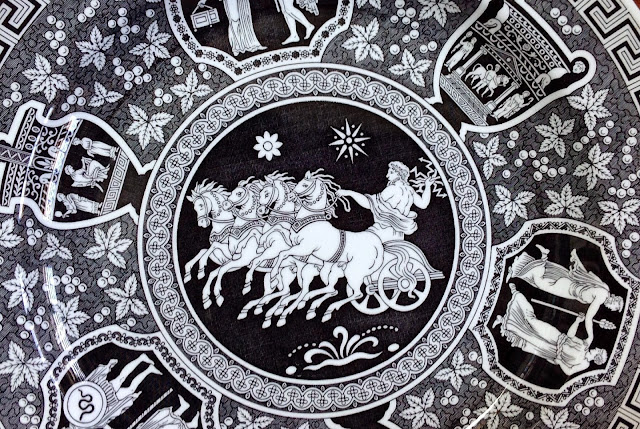 I'm a fan of Spode reproductions of their archival engravings because of their dishwasher safe durability and the historical quirks of the designs.
Despite this minor allowance, Spode designers appear to have tamped down Greek sensuality and naturalism when it came to the human form to better match Georgian sensibilities. The Spode Greek patterns are based on three different renditions of engravings off Sir Alexander Hamilton's vases. (I am impatiently waiting for my 15 pound Taschen reproduction of these engravings to arrive in the mail and have prepared an Amano chocolate bar for my postman.)

I found the original Greek urn for the above platter in the British Museum. If an ancient Greek saw the above neo-classical version, they might be quite confused as to why the most important detail had been omitted- it would be like drawing a face without a nose. Also the languid look of eroticism between the center nymph and a seated Herakles is translated above into something much more chaste that is not even likely to lead to hand holding. Unlike this politely seated man-boy, the real Herakles was a noted virile stud responsible for uncountable dalliances with both sexes. In fact, his young lover Iolaus is looking on right of Herakles. I'm not sure I want a look of burning desire across my meat platter but it's fascinating to see how cultural prejudices and commercial pressures have transformed the original. Also the Spode pattern heavily anglicizes the faces with the prominent Greek noses reduced to an insignificant squiggle.
© Trustees of the British Museum
I have 4 different sets of Spode out of 9 china sets which mark varying stages in my life. When I first moved to earthquake prone California, I was very hesitant to amass a cabinet full of breakable things. But I quickly overcame this quandary - if my china smashes to bits in the next "Big One", I was simply going to build a giant mosaic fence to commemorate my love for china and the inevitability of breakage. Even if my china were to succumb, it was completely worth the daily joy I received all these years eating off such illustrations instead of enduring the bland white replaceable bistro tableware that seems to be so prevalent in private homes now.