Showing posts with label ira. Show all posts

Friday, September 28, 2012

Shoveling Compost

Yesterday I went for a run at the Berkeley Marina when I was welcomed by tall mounds of pristine black gold.  Several times a year, city of Berkeley dumps municipal compost at the Berkeley Marina free for anyone to lug away. After trying to run a mile and half, I got excited and returned with my truck and a shovel.

The word "compost" shows up in many a bad shu review.  But after breathing in and tasting compost dust for an hour,  I'll never be so casual to overuse such hyperbole again. 

Ira has unexpectedly sent me a welcome box crammed with timely tea.  After a trying day, it warms my heart to see her handwriting. I know I've turned into a samples hoarder but winter is coming and I want to be ready.   I've thus far kept up my two month no-buy pact.  Tonight I brewed up perhaps one of the most expensive shu bricks to cross my path.  Although I am itching to use the C word on the latent wodui,  I've decided not to post anything further and let this sleep.  The shock is too much even for me.


Sunday, September 23, 2012

Finding Mr. Tong

Unlike some of you who might confidently purchase a tong of tea without batting an eyelash, I remain a one-of-everything postage collector.  I really do want to meet that one special sheng that I want to get a whole tong of.  At my rate of consumption, seven beengs in a tong means I'll probably drink it until the end of my days. I know I'm not marrying this tong but whoof- it's been much more difficult to find an ageable tea that really captures my heart than I originally thought it would be.

All my tea friends have been actively and perhaps even unknowingly playing matchmaker to find this Mr. Tong. You can see in the photo below that it can take years for me to even to seriously go through the candidates.  (But a pu-erh drinker can never have too many samples especially when one is trying to stick to a two month no-buy pact...)


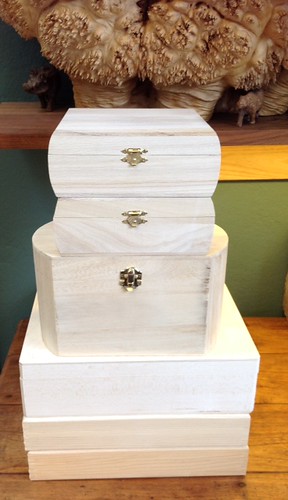
Instead of storing samples by region or year, I reserve a special basswood box for each person. Ira represents the right half of this picture with two large boxes.  (You can click on the image to see the flickr original and hover click to see which boxes belong to each tea fellow.)  Each box represents unknowable hours of research  from the sender and surprisingly there is zero overlap even without explicit coordination.

Puerh collecting is one of the few unique hobbies where you can share so fully with another collector.   I appreciate how each box is a time capsule of that person's particular palate.   A majority of these samples come from the internet and many are no longer so readily available.  After being out of the scene for six years, I'm grateful to be able to makeup for lost time.

Multiple times a day I'll peer into each box selecting a tea to drink.  I enjoy imagining each person peering intently into their computer often late into the night studying reviews to make a purchase decision.  I like to figure out their collecting habits, which was their splurge purchase or impulse purchase.  Even if I don't find Mr. Tong, I'm ever grateful that I'm even able to try such a bewildering array of teas.  Thank you.

Sunday, September 09, 2012

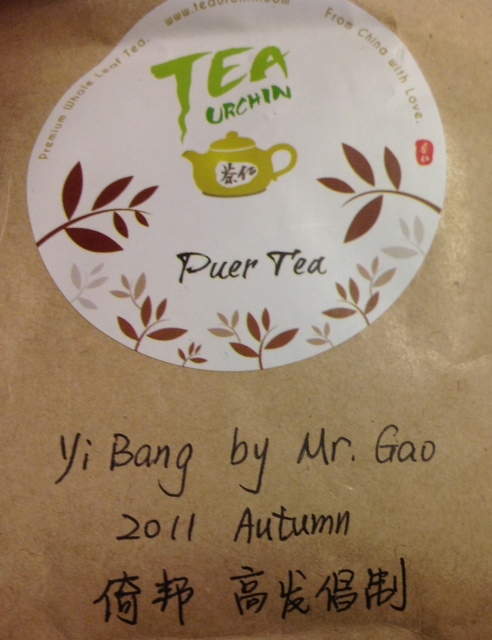
Mr. Gao's Yi Bang from Tea Urchin


(Dear Reader,  As this is anniversary weekend for me and I have to type out a post rather hastily past midnight, please excuse any inconsistencies.)

I had been fiddling with my shopping cart on Tea Urchin for months now.  Due to the hefty baseline of $20 shipping, I wasn't sure if I should gamble to get an entire beeng or go with all samples.  But this Friday, I didn't have to make any decisions because - well you guessed it - Ira provided my first introduction to Tea Urchin's offerings.   She graciously invited me to her immaculate home for water experiments with tetsubin pots following MarshalN's water post which has similarly stimulated other drinkers to go forth and experiment.

We spent a pleasurable six hours brewing four teas.  I didn't even know six hours had passed until my husband anxiously called wondering what had happened to me.  I had fallen in a tea time warp and probably could have gone on indefinitely with Ira.  More important than the tea itself,  it is a true luxury for me to be able to meet up with a tea friend like Ira- we can shamelessly go on and on obsessing about minute trivial pu-erh details and be both totally into it! She knew the way into my heart not only by tea- she fed me tasty pork ribs and some of the most delicate cigar cookies I've enjoyed in a long while.  I had to really control myself not to gobble them up while she left the table briefly.


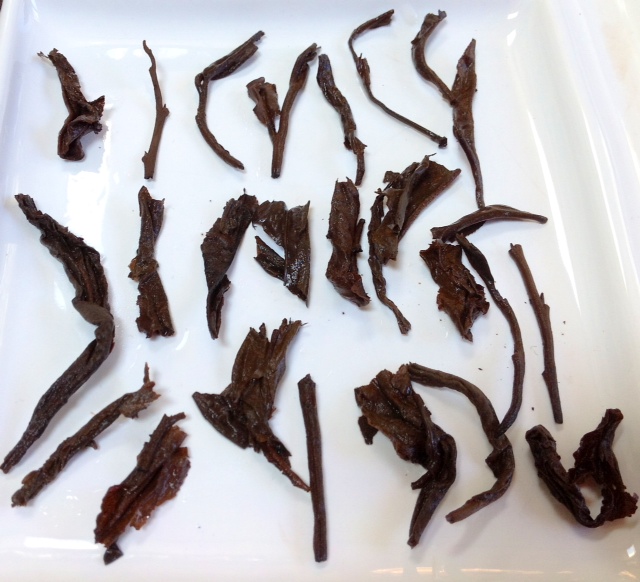
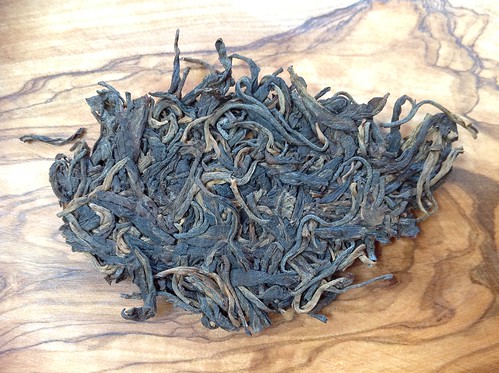
All four teas merit their own post but the Yi Bang really stood out for me as a singular experience which pushed my pu-erh palate into new territory.  This Yibang is a unique savoury tea like no other I've tasted thus far. It is all umami- I would not be surprised if this tea has the highest concentration of glutamates to be found in tea anywhere

Initially I had trouble with the slightly brackish fishy flavor of the tea, very much like the scent of pickleweed fields in the bay or a bonito broth.  We didn't get any huigan during the first few brews but when Ira provided us cups of just plain water to sip between brews, we taste an intense raw cane sugar juice sweetness which mounts after each brewing.  Even though Ira is quite humble about her knowledge, she's already taught me quite a few things about vintage tetsubin pots and water sipping between brews.

We also notice the water from her tetsubin pot is definitely far sweeter, fuller, smoother, and more rounded out than the tap water in the electric kettle which tastes markedly thin in comparison. I vow to keep my eye out for such a kettle on ebay although I fear getting re-addicted to trolling ebay for hidden treasures.  I could just pay up on hojotea on any one of their lovely high-end kettles but I'd be depriving myself of that special pride of bargain hunting prowess every time I boiled water in it.  I think getting into tea accoutrements is a danger all in itself and I've always tried to spend money on tea rather than teapots. But a proper iron kettle I see now is worth the investment. I've had some modern disappointments in decades past but I didn't know much fifteen years ago.

Back to the tea- is this savoriness in the tea the work of Mr. Gao or is it a regional hallmark of Yibang or does it only exist in my head?  In wine,  the vinter's handiwork is critical to the finished product more so in bad wet years.  In pu-erh processing, the quality of the leaf dominates the end product. However in autumnal productions, the skill of how shaqing (kill green) step is performed is critical in bringing out the intensity of the tea without burning the leaves.  I've been avoiding autumnal productions due to some weak examples I suffered back in 2006 but this autumnal beeng is unique enough that I'm game to try more.  Surely the quality of this tea must attributed to the able hand of Mr. Gao who is shown dry frying the wok with his bare hands.

Ira did not get the same impression of this tea and when I try to read other reviewers, Eric's discipleofthetealeaf post and Hobbes, I'm surprised to find very different flavor notes which don't match my own.  I should stop writing flavor reviews altogether.  The brackish savoriness of this Yibang broth is not yet to my immediate personal preference but I want to taste this this tea or something like it every few years to refresh by palate memory.  I'm quite curious how such a tea would age and I would include a new sample in my order.

Ira again sent me away with mind-bogglingly generous bagfuls of tea including a 1960s Dan Cong and a slew of Da Hong Paos amongst some pu-erh I cannot buy easily on the internet.   I should not be buying any tea at all for a few months to do justice to her  samples. 

Sunday, August 26, 2012

First Hit - 1996 XG Butterfly Tuo

Finally we meet, the 1996 XG Butterfly Tuo from Life in a Teacup.  This tea has so bewitched Nick Herman that every time I see a comment by him,  I  half-expect an apparition of his beloved Butterfly.  He says, "it has sent deep, deep energy coursing into my veins which I still felt the next day. Incredible."

Who doesn't want to feel an extra-day extension of "incredible" energy.  You're definitely getting bonus  value there.  Ira brought this for us to try yesterday but I was too tea drunk on the 8582 so she generously left it for me.  When I open the pouch, I'm hit with a curious vegetal mineral nose more like seaweed or dried kale.  It no longer smells like sheng.

I brewed up all the loose leaves and fannings not in the photo as I wanted to save the rest for Ira.  The first brews were still trademark XiaGuan- drying, slightly smoky and astringent.  This sample of tea can proudly proclaim dry-aged storage despite ImmortaliTEA having received a extremely moldy version- the perils of buying aged puerh on-line.   My here example is as dry stored as they come and I was going to use a schoolboy's phrase involving nuns but the censor tells me such crude aphorisms won't do.  I first used my new three-walnut toy pot then moved to a yixing pot to see if it would improve things.   I realize I've gotten to the tenth brew but the magic is simply not happening for me so I postpone the later brews for the afternoon.

I've been thinking much about Ira's first real hit of pu-erh- a 60 year old aged sheng from a casual acquaintance.  She didn't know much about pu-erh then but she did not have to think much about whether or not the tea was good. The tea's greatness simply floored her.  How can one even ever hope to order something from the Internet to measure up to such a first introduction. Everything else must be quite ho-hum - it's a gift and a curse to be sure.  I'm pretty sure she will not be moved by this tea.
(The tea quilt in the photo was hand-made by Ira and adds an extra cozy touch to my tea session.)

Nick Herman has deemed this XG an "excellent tea".  Great for him that he could receive an extraordinary session from this tea but somehow I can't even manage a passably good session from this 300 year old arbor tea.   The tea barely holds my attention, my mind is on some Xiaguan auto-pilot conditioned from all the other XGs that dried my mouth in predictable patterns.  (Sorry sorry Nick. I just am not feeling this tea although it was the only tea I drank all day. Who's ever going to recommend tea to me again after this and Hengli Chang and the corked CGHT...)

I try to force my husband to taste some and I interrogate him Guantanamo style. The prisoner won't talk so I have resort to new gentler tactics.  When I first started drinking sheng, my first beeng was a smoky CNNP production and I loved it.  The beencha was so different from all the other polite greens-  senchas, bilochun, TGY, and their ilk I was drinking back then. Even whatever small amount of complexity the sheng had was enough to send my senses into appreciation.  Too bad I didn't save any of it because I'd love to know if it was any good after all.

When I return to the tea in the afternoon after a hike, I barely quaff two tiny cups and the astringency starts burning my insides. A seventeen year old tea still going this strong!  Tight Xiaguan's definitely benefit from some humid storage early in it's life because this tuo is too dry for me.  But I'm not going to give up on dry storage altogether based on this one data point just yet.  I luckily have a few more provided by Emmett of Cha and Kungfu blog.
 
Here is a behind the scenes look at where this blog is produced.  You can see my first photos of a tidy walnut tea pot set are altogether misleading as you can see a dozen tea paraphernalia cluttering the table.  My husband tore out the ceiling while I was in Dubai and India early this year and he put two skylights so I can enjoy tea and browse my maps in a sunnier setting.  

Saturday, August 25, 2012

Tea for Two - 20yr 8582 vs Hengli Chang

Since last weekend, I've been scrubbing down the house for a special tea visitor.  I wanted to try the  traditionally stored aged sheng MarshalN sent with someone else who loves pu-erh.  Ira who I dubbed the most sensitive man I've ever corresponded with- turned out to be a lovely lady and a mother of grown children.  So I felt very comfortable inviting a complete stranger I met on the web into my home- something I have never done in my life.

It's always a bit nerve wracking meeting a virtual acquaintance in the sunlit world.  But the afternoon went by so pleasurably and so quickly, we talked and brewed for four hours.  I was so absorbed with Ira's company I totally forgot to take photos. The shot below is before Ira's arrival.

I had planned to try the 20yr 8582, 2003 7542, and some traditionally stored shu but we ended up with a smaller program.  We had the 20-yr 8582 brewed two different styles. I was sampling it in my new walnut teapot before Ira arrived.  She didn't get too much of the wet stored taste from the 8582.  Although I hadn't planned to, I brewed for her 1997 Hengli Chang to show her a sheng with an   unmistakable shicang flavor.  Hengli Chang's Bulang bitterness was much more assertive than I remembered- perhaps due to the fact we had the 20 yr 8582 first.

Ira brought out her gaiwans and she deftly flash infused the 8582 for us in the second full-sized tasting of this tea.  I'm not sure what either of us was expecting.  Mouth orgasm?  Ira talked about her first aged sheng experience which led her down this rabbit hole.  She was most casually served a ~60 year old aged sheng at an acquaintance's house.  The acquaintance's wife was no ordinary tea drinker and he insisted they try some of her tea.  Apparently the acquaintance could not find his wife's stash and so he had to use the spent leaves left over from his wife's morning brew.   Incredible, thick and powerful-  it hit her over the head with sheer amazing aged sheng magic one only reads about these days.  How can this tea compete I wonder.  Let's just say Ira was "unmoved" by both teas today, and she dinged the Hengli Chang for an "unpleasant" aftertaste. 

The highlight of this 8582 for me was when I distinctly tasted sweetness on the left roof of my mouth. This was an exciting first for me and I almost thought it was a trick of the mind.  I told my husband about it later and he didn't think it physically possible.  We both learn that the back roof of your mouth, called the soft palate, does indeed host a myriad of taste buds and minor salivary glands.  Actually some fish even have taste buds on their tail fins.  I wish I had some taste buds on the tip of my left pinky and I could just swirl my pinky around at tea tastings. 

I'm still on the fence about traditional storage.  I could tell this 8582 is superior to the Hengli Chang with it's complexity, clarity, and potency.  But I'm not sure this type of tea would be at the top of my fantasy tea list or tea fantasy list.  Well now that I've had aged oolong and they are so so easy on the mouth and the mind so to speak.   Tea is for me in a large part about pleasure, and while the taste of the 8572 is stimulating and interesting, I think I only need something like it only once in a while due to the trad-stored flavor. It's not something I voluntarily crave. (The photo above shows bubbling of the leaf- something I've only seen in aged sheng.)

Besides tea chat, it was also totally fun gossiping about various blogs and bloggers.  We discussed  the contrast between MarshalN vs. Hobbes.  MarshalN despite his liberal arts background is relentlessly rational in his approach.  Hobbes despite his engineering background is more prone to romanticism.  Ira is firmly on Team MarshalN it appears. The dragon and the tiger, both have their charms and flaws which are to be savored for another post.

Ira also brought me a bag of treasures- a shocking bounty of aged sheng, including the 1997 XG Butterfly Tuo and a Menghai 8972(ca 1990) among 4 others which will power this blog for months.  She also gifted me lovely teacup pads she had quilted and they will make a photo appearance soon. Truly she is my tea fairy.  I don't know what I ever did to deserve such generosity but I feel like the luckiest tea drinker in the Americas.

 (Actually my husband who had been completely disinterested in joining us today but after dinner  said he wanted me to brew the spent 8582.  It infused 6 more times still giving a surprisingly good show.  At first the only thing he would say is a tight-lipped, "I don't dislike it." But after a few rounds,  even without prodding said "This is good tea."  Dear readers- this is high praise.  Thanks MarshalN!  )


Wednesday, August 22, 2012

Call for Help on Two 7262s from the Nineties

The ever generous Ira sent me two mystery samples which were both from a 7262 recipe - a classic Menghai shu recipe. When I brewed up one of the samples last week expecting shu, I was surprised by an aged sheng taste. 


Ira says the 1990 version is a lightly fermented shu which has the familiar green neifei of Langhe. But how lightly fermented was this cake?  YS sells a 2003 Langhe which mentions the Langhe style of light fermentation employing  "less heat and shorter times". I definitely will give the 2003 sample a go out of sheer curiosity.  I'm all for light fermentation if this is the result.

 When I tasted Ira's younger 1999 7262 version, it's mostly sheng and in a blind test, I probably could not taste any shu in it. I could detect a slight wet storage like taste.  Ira found one pliable leaf that looked like shu.  Ira sent photos and we are asking the readers for any information on these two beengs.


In 2008, Ira bought two 7262's in a San Francisco Chinatown dried seafood/misc ingredients shop on Grant Street. Ira eventually swept away everything on their top shelf - 5 in total with only 3 beengs with known dates. The 1999 7262 had a sticker notating they were packaged in 2007 by an outfit called "cao xiang min (taste) cha (tea)" .     
 
That's the trouble with buying beengs from small stores who don't specialize in pu-erh. They rarely know too much about their wares and so it becomes kind of a crapshoot.  Oakland Chinatown has a few stores carrying beengs with the ubiquitous beat up CNNP zhongcha wrapper. Who knows what's lurking behind the wrapper and the store owners  often have no clue.

But in Ira's case, it worked out to a most happy ending because the 1990 is a lovely tea. (This is a total aside but I really like pictures of two beengs side by side for some reason...)


Friday, August 17, 2012

Pleasure of Trading Mystery Samples

For many of my friends and acquaintances, I'm a food fairy of sorts.  It's always a pleasure to be able to provide something they would not have had without my intervention and a double bonus if they really like it.  I gave out 70 boxes of Rabbitos Royale last year which remains my biggest hit to date but I like to keep my food surprises more targeted to specific palates.  But on the flip side because I've tried so many things, edible surprises are getting rarer and rarer for me.

But yesterday I was so pleasurably surprised at work that I am still smiling about it.  Recently I traded samples with the ever generous Ira who is my tea fairy.  On top of the CGHT and a Nannuo, Ira gave me four mystery samples which looked like shu and I took one to work yesterday not thinking much about it.


I was rushing about trying to get my brew in amongst the other coffee drinkers in our company's rather tight kitchen.  The leaves look dark but it doesn't look quite right. I only took a few leaves in case things don't turn out.  But the brew looks light- that's not shu I think to myself.  One sip and I know it's not shu or at least the kind I drink.  OMG I think to myself- it tastes much more like the aged sheng I've had except much much mellower.  I brew up the first few cups and run back to my desk. It has a beautifully comforting sweetness like maple syrup with a warm qi.  This is the back rub Israel is talking about. I do not need to send my Heng Li Chang to Berkeley Massage school as he suggests.  This tea already knows how.

The brew did not reveal any complexity or depth in my rather casual work brewing setup but it melted some bubbling tensions away. (I had to restrain myself from boring you with a rant on inadequate engineering designs.) There is a tiny tiny bit of wet storage which goes away. I pleasurably drank the rest of the tea which lasted 7 cups until it gave out. Probably with hotter water, I could have pushed it further.

Mystery Sample B was a 1990 CNNP 7262 shu that has been lightly fermented.  Ira also had included the answers for me in a sealed envelope hidden in the box. The Neifei says "Menghai Lang He Cha Chang".  I would appreciate any information regarding this shu. She also sent me a younger version for comparison.

I desperately want to try both examples today under more ideal conditions but I have a rather hot date with another tea I set a week ago.  I need to keep my palate clear.  Otherwise it's like showing up for a first time date already having kissed someone else. (Actually I have a raffish neighbor who does more than kissing before his dates.  His latest mishap involved a dead cell phone battery. Having missed some rather important texts, he brought two ladies back to his place only to find his current steady girlfriend waiting for him in his bed.  He is NOT a tea drinker I might add.)

Monday, August 13, 2012

Wet Storage Sensitivity

One of my favorite novels of all time is Patrick Susskind's Perfume- a brilliant tale of a psychopath born with a singular sense of smell.  Not satisfied with creating wildly successful botanical perfumes for smelly but wealthy Parisians, he ups the perfumier's craft a few notches by distilling the essence of virgins.  My college roommate who is currently finishing a postdoc on olfactory systems of drosophila tells me that at least in the fruit fly world, virgins do smell more "yummy".  Her current research involves heightened olfactory sensitivity for hungry flies.  Even for hungry humans, our sense of smell is more intense than when we are sated.  Perhaps for this reason, more fragrant tea sessions might be preferred before a meal than after.  But is a more receptive sense of smell better for enjoying wet-stored pu-erh?

I now have experience enough to support both sides.

This Saturday's tasting of two versions of the same 2005 Chen Guang He Tang Menghai Yieh Sheng  both stored under different conditions was a most instructive lesson.  I was lucky enough to receive samples of this Chen Zhi Tong production from both MarshalN and Ira. I initially thought MarshalN's sample was also traditionally stored due to white mold on a few stems but he tells me this is "natural storage" under humid conditions than tradtitional storage. His was admirably enjoyable and I could not detect anything of the wet-storage in the brew.  One whiff of Ira's sample told me his cake was quite mature.  I quadruple rinsed it, then had to throw out the first three brews and still I just could not keep this tea down.   MarshalN helpfully suggested that such cakes could be aired out in the wrapper for weeks to months so I will give the extra wet-stored cake another go in a month if only I can find a place to air out this cake.


Ira, perhaps one of the sweetest of men I've ever had the pleasure of correspondence, wrote me that night and said he couldn't smell very much on the original source beeng.  I tried to sniff the cake again the next morning and couldn't even manage to open the bag as I could smell the offending odour through the plastic bag.  So I asked my husband who graciously agreed to do a test.  To my complete surprise, he dove his nose into the bag inhaling vigorously, even took out a piece to do a contact sniff.  I was quite worried an errant tea leaf might get stuck up a nostril as such was the force of his snuffing.  My husband said he could barely smell anything. I got curious and sniffed the open bag at a six inch distance. The mildew smell was so overwhelming,  it triggered my gag reflex again (sorry dear reader for such details).

Ira's 2005 CGHT has a different wet-storage smell than the 1998 Heng Li Chang or the 2003 Sungsing Bada. Although I wasn't the biggest fan of the 1998 Heng Li Chang,  sniffing the brewed leaves were the most intriguing and pleasurable part of the session for me.  So this CGHT a case of wet storage or poor storage? I enjoyed for dinner tonight a most excellent apple-smoked salami from Olli. I love sniffing that porky musty smell and I never peel my salami's preferring to eat the moldy skin for extra flavor.   I normally love stinky foods cured by mold such as washed rind cheeses. So what is different about the second CGHT?
  
Then by pure chance a shape of an answer came to me. A friend and I wandered into a used bookstore in downtown Oakland during our lunch hour.  After five seconds of browsing their cartography section, I literally ran outside as the smell of mildew was so overpowering which reminded me of the CGHT session.  Of all the book lover's who were crowding the store, no one seemed to be holding their nose.

A hypersensitivity to mold I think may prevent enjoyment of the majority of wet-stored sheng available in the West.  I read that allergy sufferers and asthmatics can be more sensitive to mold than the general population so readers can write me to see if there is a correlation to appreciation of wet-stored sheng. But those hypersensitive need not lose hope on aged sheng which tend to be wet stored.  Well done wet storage as the samples MarshalN has provided prove to me that I need not be afraid of traditional storage. Good wet-storage can be quite pleasurable, but how do I go about procuring more of this kind of wet-storage?  TBD...
 

Saturday, August 11, 2012

Tale of Two CGHTs

The joy of not having children or a pair of billy-goats that need your constant attention is being able to block serious time for tea.  Of course I may die lonely as many of my friends remind me but I may just adopt a pair of Nubian goats who can sometimes be even more loving than flesh and blood progeny.  And if they are not- I can enjoy fresh goat stew for which I have many good recipes.  (No offense to the brave parents out there who are sacrificing everything for the continuation of our species. )

Today I sampled two 2005 Chen Guang-He Tangs blended by that leading expert- Chen Zhi Tong.  I'm assuming he's still leading away although you don't see new CGHT cakes past 2009 but you see his articles going strong in the Art of Tea magazine. He tends to write more about market forces rather than the tea itself which makes me think there is more businessman in him than tea lover. Oh how I wish I can read more than 2 pages of  "Hidden Rules of Pu-erh" in AoT vol. 10.  He tends to bash big factories but he does bring out relevant points about how there is an oversupply of pu-erh in storage right now which exceeds what the end consumer can absorb.  I've been waiting for years to benefit from speculators dumping their hoard of tea but it hasn't happened yet.  When I heard Mr. Chen speak in Pasadena in 2007,  he impressively anesthetized both sides of my brain going on about creating sustainable market conditions so let's see how his actual tea compares.


The first CGHT is from MarshalN which he labeled only as "2005 CGHT".  You can see that the above chunk is quite sleek and a few leaves sport white mold.  MarshalN corrects me that this tea is not traditional storage but rather has undergone natural storage in a humid region, i.e. Taiwan.  Plot spoiler- when I see how plump and respectable the brewed leaves turn out,  I'm suitably impressed how tightly these leaves have been rolled.

The second sample from Ira is the 2005 CGHT Menghai Yieh Sheng - available at Hou De for $165.  MarshalN had suggested this very cake as a Birthday Beeng selection.  I assumed my two samples are two different blends based on leaf composition. The Yieh Sheng has a rather messy look. But MarshalN informs us that they are indeed the two same versions which now makes this tasting all about storage conditions.


Now I have to carefully choose which tea to start.  You definitely want to progress from light to heavy in a wet storage tasting but this may be tricky if you haven't had the teas before. I chose MarshalN's to go first since one sniff of Ira's Yieh Sheng points to more serious wet storage and the more plentiful white spots of mold confirms this assessment.

MarshalN's cake has a nice thick mouth feel and you can still taste and sniff a remnant sheng youthfulness in the leaves. You get good huigan in the second cup.  Really really tight rolling that we saw in the dry cake results in leaves that refuse to unfurl completely. This is a solid respectable cake and as I drink it, I'm strolling along a familiar path to sweetness. This sample provides a critical reference point for my own dry stored cakes. Berkeley aging will probably take twice as long to achieve where this cake is currently.


The HouDe version however is another story.  It has considerably more noticeable wet storage.  I rinsed it four times for good measure but even the subsequent three brews I pitched.  This wet storage taste is nothing like the muffled maple syrup of '97 Heng Li Chang or the '03 Sungsing Bada.  It has a lavender/cedar/mildew taste profile that I just cannot get used to. I try and try and I try but I have such a strong visceral reaction against this cake that I can't swallow much of it- my natural gag reflex does not permit me. This isn't granny powder but rather granny's closet. This cake supposedly blended with a wild Banzhang base may be beloved by others but it's moot to me since this is not a cake I can even swallow.  I will let the sample air out a bit and make another attempt in another month.

The HouDe leaves are considerably darker and thinner but similarly did not want to unfurl. I carefully pried open a few leaves.  The HouDe brews expectedly darker and has completely lost it's sheng youth. This is the most mature 2005 I've tasted.  These two same cakes stored under varying conditions cannot be more different.


I'm extremely grateful to Ira for saving me $165(multiple Korean-style bows to Ira here).  This is one of the deep pitfalls of expensive aged sheng which has been traditionally stored and is highly recommended by others.  It's one thing if you thought a cake was over-hyped and over-priced but it's another thing altogether if  you can't even bring yourself to drink it.  Emmett mentioned that he could not keep down a highly regarded 2000 Jing Tea brick.  I guess Emmett and I are both in the "highly sensitive to wet storage" group. There may be others out there but you don't read a lot of gag reflex trigger reports on some of these wet-stored sheng. I actually hesitated a bit before writing such an unsavory report and thought maybe I should do another tasting next week. 

The important lesson for me today is twofold.  One- the well regarded traditionally stored sheng available to the Western drinker via internet vendors that other people seem to enjoy is not for me. So I'm really better off not buying any aged sheng on the internet especially from vendors known to carry really wet stored stuff.  But point two is that happily, there are traditional storage examples that I actually enjoy.  I think I might have given up on wet stored cakes altogether had it not been for MarshalN's box of traditionally stored samples. So a deep bow of gratitude goes out to MarshalN.

I have five more samples to go through but my mind is whirling with all sorts of possibilities why I can't enjoy something that other tea heads do.