Showing posts with label aged sheng. Show all posts

Friday, October 31, 2014

Rainy Day 2004 Wet vs Dry Update


These two factory teas are about the same age- or purportedly from 2004 and potentially with some wild tree content.  Your eyes might pop out at the ever so light straw colored brew and green green leaves on the left but this tuo has been drying away with me in Berkeley since Feb of 2006.  Even back in 2006 and in comparison with the 2004-2006 versions of this cake, I had no doubt as to the age of this tuo plus it had a convincing factory stamp.    Which brew do you think is more bitter? 


The humid stored brew on the right still holds onto an obvious plantation bitterness while the barely aging wild tree tuo on the left is smooth to drink now as it was in its youth.    

Behold the '04 Changtai Brick with a Menghai Brick Tea  猛海茶磚  label:

I recognized this brick on ebay from an old puerh.net forum post where Tehahlia from Indonesia provides some intriguing information:
"This brick is going for about SIN$5, isn't it? There are fake ones in the market, so be careful when you hunt for it, the similarities between the real and the fake are hard to tell.

The first production from Chang Tai's new factory in Jinghong city, using a blend of old abandoned leaves and cultivated ones. Most of these bricks were snapped up by a Hongkong tea vendor."
At SIN$5, it probably wasn't the finest Banna brick and this one certainly tastes like that kind of cheap plantation brick; it must have been a tongue scraper back then and such tea demands humid storage.   I brewed up so little that I wasn't able to differentiate two set of leaves to confirm a blend of older leaves with taidi cha.

I was surprised anyone would even bother to forge such a low end brick but I remembered back then you could get an entire 6 FTM beeng or a Lao Tong Zhi for just a few bucks.  You can see the Changtai wrapper is quite bug eaten and one whiff lets you know this cake enjoyed humid/light wet storage although it has no visible signs of surface mold.   I'm assuming the 401 means 2004 first batch.   The specimen I have compares to other 10 year olds. I would be okay to buy this for $16 with shipping- the Changtai part really doesn't matter to me that much. The cheapest deal on ebay is $16 with shipping but I wasn't diligent so I paid a tenner more.   It's not the best, it's not the worst. I don't have that many humid stored examples yet so it's okay to fill out.

Next. This age defying tuo is the '04 Xiaguan Wild Tree.  It smelled incredible when it arrived- it emanates the fragrance I associate with fermenting overripe blackberries when I pick them later in the season.  The intensity of the scent on this tuo fluctuates with the seasons being most subdued during the winter.   Like it's XG beeng counterpart,  this tuo is a mellow brew without the usual XG mouth drying powers.  You can see a fair amount of huangpin and older leaves which must be the old tree part.  And is customary with XG style- the leaves are all chopped up and the compression so tight, you need to sweat and bleed to get some flakes.  

This XG tuo is aging much slower than my 2004 plantation tribute melon of the same size -250g with equal or greater compression.  My melon has been progressing respectably and is entirely drinkable now even for me so it's more leaf composition rather than compression or storage which keeps this XG evergreen. The excess carbon in the huangpin and the older leaves make it extremely slow to ferment.

(My husband cracked up in telling me last month that while sleep talking with my eyes fully closed,  I said, "Hey do you want to see my melons."  He didn't realize that melon was actually a puerh form but I whipped them out for him to clear up any confusion.)

Because the heady fragrance of this tuo is so lovely- I shudder at the thought of this scent being contaminated with a shicang aroma.  I don't mind this tuo is never to age. I've easily gotten a thousand huffs out of this tuo and the fragrance alone makes this worth holding it young forever. 

Sunday, October 19, 2014

Flashback with Samovar's 50s Vintage Sheng

About ten years ago, I took my husband for his birthday to Samovar Tea Lounge in San Francisco to try their 50s aged puerh.  Their menu confidently proclaimed:
"1950 Vintage- Ancient and amazing. Complex for each of the 7 infusions you will enjoy. This is the end, as we purchased the last existing 10 pounds of this unparalleled brew. Green processed, this is the old stuff, the good stuff. Not for beginners"
We were dubious but curious.  They also listed a puerh from the 30's:
"1930 Vintage- Truly archaic. Camphor, minerals, molasses. Taste Mother Earth. Sip, and time-travel to 1930 China. Where were your grandparents? Where were you?"
Probably their menu wins the cake for cringe-worthy copywriting. ( I'll include more highlights at the end just for late night humor. ) The owner Jesse Jacobs most likely handcrafted those very words and if you have ever seen him speak, you will not be surprised by such flashy confrontational descriptions.   Samovar Tea Lounge is a brick and mortar SF tea cafe serving a wide spectrum of teas- oolongs, sencha, lucha, assams, ceylons, rooibos, yerba mate, herbal tisanes, and puerh alongside light fare.   They used to list 8 puerh selections on their teahouse menu back then compared to the 3 loose shu Imperial Tea Court served.  Now Samovar Teas has pared down their puerh selections to serve three loose shus with two of them being blended with cacao, yerba mate, essential oils and such. They call their unadulterated loose shu "Maiden's Ecstasy"; I wonder what Hong Kong grandpa would think about that.  I don't know any maidens that would go into ecstasy over a cuppa of loose shu.

I had asked my husband if we should try the tea from the 30's but he stoically insisted the 50's tea was good enough for him.  I vaguely remember the price was something like $23 vs $38.  The waitress brought out a yixing teapot crammed full of tea leaves.  It was aged loose leaf sheng and the brew out-lasted more than a gallon of water despite the specific "7 infusions" listed on the menu.  My husband asked the waitress to put the spent leaves in a to-go cup and brewed it continuously the next day as well.

50's vintage it certainly was not but it was a good robust tea- very mineral tasting like licking a limestone cave.   Of course I knew squat about puerh 10 years ago so I can only guess that it was a twenty year old if that.  The tea was clean and bright tasting- no traditional storage mustiness at all and it was probably a sheng.  Shus normally don't possess that kind of endurance but I didn't know the leaf rub test back then.

I have always wondered what the supposed 30's tea was about but they removed it from the menu shortly after my visit so I never got the opportunity.  If you per chance did try this tea back then- please fill us in!


As promised, some over the top tea Samovar menu descriptions just for late night giggles:

Creamy Oolong- Velvet and warm milk. Downy, seraphic caresses for your tongue. A most memorable gustatory journey with each unfurling leaf
Oriental Beauty- Ambrosial, sweet, dark, and so complete. This brew will assuage your worries and float you to the elysian ether. A haunting flavor with an evolving complexity

(I really should hold a contest for the most ridiculous tea advertisement.)

Friday, October 17, 2014

Dry 2001 7542 vs the Lucifuge 90s CNNP

To ease my mind from encroaching ebola fears, I thought I would take my diversion in tea this afternoon.  Up first is a random CNNP brick from ebay.    You can see there is generous white frost on the surface and stems inside. After all my adventures in mold, I actually did not bat an eyelash when I opened this brick. The storage of this brick was advertised as:
"Clean, Ventilating, Lucifuge, Dry, No Srange Smell And Pollution"

I have some vague notions about what this "Lucifuge" condition is about. To regurgitate wikipedia, lucifuge comes from "lux" latin word for light plus fuigio meaning to flee.  "He who flees the light"!  Lucifuge surely must be storage under dark conditions. But if it also means Lucifuge-the demon in charge of Hell's government oversaw the aging of this cake, I'm down with that too.  Most likely it would have been one of his minions as I'm sure the real Lucifuge is crazy busy with weightier matters.

I must have graduated from wet storage 101 because I can drink it without gagging. That is something. The brick must have dried out for many years as it does not smell so bad and the brew is lighter brown so the wet storage was not too overdone.   That moldy shicang flavor has finally grown on me.   I've drunk this tea multiple occasions without ill-effects and I'm curious how such a brick will dry out here in Berkeley. The slightly wet 90s Ding Xing is doing so much better so I'm keen to load up on more slightly wet cakes.

The ebay listing photos did not show any signs of mold so I wrote the vendor who kindly will send me a dryer version.   Is this brick really 15 years old to merit the 90s designation?  At least 8-10 years I would guess and I should get some younger trad stored cakes to compare.


As an antidote, I finally open up the 2001 7542 sample Jakub sent me that started the whole Luke Skywalker dry storage meme.  It's like eating a slice of English cheddar after being assaulted with a ripe morbier.  This 7542 is a pricey chunk of pu from Sampletea and I'm happy he sent it to me instead of another dry storage hater.  I was saving it for a dry vs. super dry comparison but I went for it today.  

Compared to the 2003 7542 MarshalN sent me,  the 2001 version is rather of ho-hum but still a pleasant aged experience. It's not terribly exciting but it's drinkable which is more than what my cakes are now.  But if I had to pay triple digits for something like this now, I would be kind of upset.  I'm glad I didn't splurge on too many expensive shengs back then only to see them hollow out like this.   However if my ten dollar ten year olds start tasting like this in a few years, I would not mind at all.  

Saturday, September 22, 2012

2000 Fuhai Yiwu Yesheng Cha

Many times I drink pu-erh and I'll be indifferent to it's charms or lack thereof.  Sometimes I have to really make an unnatural effort to get into a tea. I have to bend my noodle to this way and that way, research the provenance of a tea,  and try to come up with reasons why I like or dislike a tea.  When a tea is just flat out boring, one can't bore readers with boring descriptions of boredom.

So today when I was trying out the mini-pot Emmett sent me,  I was surprised by the instant chemistry between me and this tea. I just liked it and really could not even think of reasons why.  But I didn't have to. Imbibing this tea brought instant relaxation. 
There's a blog I like called You Are Not So Smart which covers all manner of self-delusions. David McRaney, the blogger, writes that the actual reasons why we think we like something follows after we like them, not the other way around.  I.e. we are forever rationalizing why we like or dislike things but after we subconsciously have made up our minds about it.


I had put in Ira's sample mistaking it for the 05 Yiwu Zheng Shan Yesheng and found something different.  The aged taste is soothing and clean without any hint of trad-stored talcum powder taste.  Not too dry(XG Butterfly), not too wet (Hengli Chang Bulang),  this tea was just right.   

Despite it's Yiwu yesheng designation,  I could not detect any sort of Yiwu fruity delicacy or wild tree strength. Is it aging or the tea leaf being a blend?  It's not a complicated tea but it doesn't matter when you just want to wind down instantly.   It was a gift from Ira so I wonder if my mind will change about this tea if I knew how outrageously it was priced.    

Tuesday, September 04, 2012

90's Menghai Under The Microscope

A week ago I had been planning to treat myself to a USB microscope for about $70-100 when I found this tiny thing on Amazon for $3.50 including shipping from Hong Kong. I read people had clipped it onto their iphones to take some budget microphotography. I'm totally into $3.50! I added brass coinage from Emperor Chi'ien Lung's reign as reference for size- if not for value.

I hunch over my desk tonight for an hour fiddling and taking dozens of blurry photos. I'm using my ipad camera even if it's woefully inadequate because I can upload direct to flickr and that counts for a lot. I may try a real camera this weekend.

I whipped out the sample of the 90's Menghai 8972(which I dubbed dry and dreadful) too see if a peek under a cheap ass microscope can shed any light.  Are the white spots mold or the bloom- a crystallization of the oils in the leaf also found in cigars.  I don't see filaments so I'll go for crystallization.  The hairiness is a bit scary looking- like spider legs.


Not bad for $3.50 but not great either.  I have a dear friend in drosophila research who has access to a two-photon microscope well as other powerful equipment for doing microsurgery on fly brains. Alas she lives in San Diego. 

Peering under a microscope tonight does nothing to solve the conundrum on why this tea was so bad. But I don't know what I'm looking for yet as this is my first peek but I have all sorts of grand plans for this little magnifier. 


Saturday, September 01, 2012

Stone Face of Menghai 8972 Circa 1990

Nick Herman recommended I give the "90's Menghai" a try after the XG Butterfly fiasco.  Who happened to leave me just another shiny mylar packet labeled "Circa 1990 Menghai 8972" for me last week. The incomparable Ira!

I gave this tea a go this morning without reading anything about it because a blank mind is an open mind.  I really really triple really wanted to love this tea for no shortage or reasons:
  • I'm a tea lover.  It sucks for me as much as it does for anyone when teas don't measure up.
  • Ira left if for me as a gift - I don't want to be the ungrateful teachum that I am.
  • I felt bad I dissed Nick's beloved Butterfly tuo.  It was like trash talking his girlfriend.   I don't wan't to do it again.
  • Ginkgo seems a sincere vendor who specializes in dry stored aged pu-erh providing samples at a reasonable price. Such vendors should be heartily supported.
  • I don't want to end up as yet another tea controversy link on teachat. But there's no avoiding that today. 
  • I'm looking to add good aged pu to my collection.  If I love it, I can get my grubby hands on more with just a credit card. I don't want to have to go to Hong Kong and Malaysia just to buy tea.
So I snipped open the package hoping for the best. I sniff a dry aged sheng smell but I also get a whiff of the faintest barest hint of something- wet storage or even wodui?


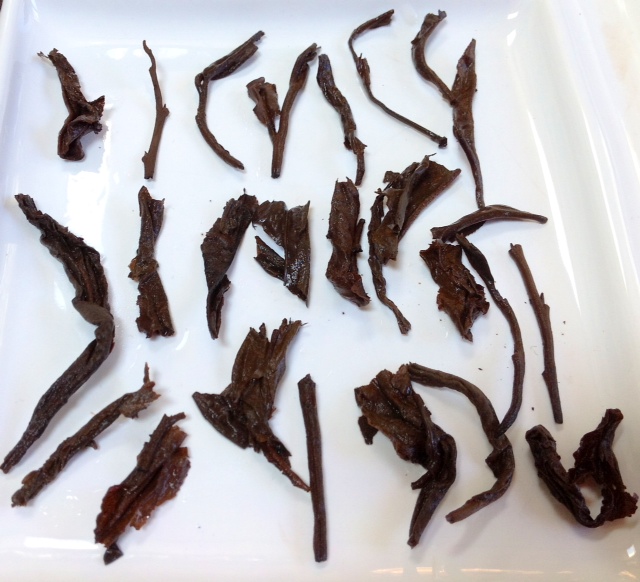
I was expecting aged sheng because the leaves look dark greenish despite the unnatural darkness of the photo above. But it just brews up just too dark and it doesn't taste all like aged sheng nor does it taste all like shu.  A peek inside the teapot quickly shows dark and light leaves. A blend then.  It makes complete sense as I drink it.  The cooked part of this tea is much more obvious and dominates as it cools. The shu taste is undeniable when this tea is cold.

I get to 8+ brews without this brick giving up it's drying astringency.  The mouth drying power of this is brick so formidable,  I vow to pre-buy some of this 8972 as a natural remedy for when I need to control my drooling in my nineties.  Hopefully I'll be spared such indignities of age but it's always good to be prepared.

In the ninth brew I sense a mouth coating.  I hesitate to call it a creamy mouth feel- more like skim milk which is not entirely pleasant.  I'm trying hard to find the best qualities of this tea and I'm coming up short again and again.  I just can't do it. I go on line to find what other's have appreciated.

It's beyond relief to find Jason's review from the hey day of pu-erh at live journal:
"Please don't let this be what I have to look forward to when I taste my cakes years from now. *panic attack* If this brick is indeed uncooked, this is possibly the worst I have ever had. The milkiness really made this experience a nasty one.'
Whew, I'm not an unreasonable suspicious crank! Jason is talking about a Hou De version of this 8972.  Even in bear's time there was great controversy over whether it was all cooked or a blend. You can see below this cake holds at least three different ages of leaves.  I apply the test I learned from bearsbearsbears himself and sure enough it doesn't take much to rub some of the darker leaves to make them fall apart.  The really black leaves are rubbery. The greenish leaves hold their form when rubbed. 

Personally I would judge it a blend and definitely not a pure aged sheng as the vendor advertises.  But this brick's composition doesn't matter to me because I find it dreadful all the same.  Even if it was a blend, I would shell out $120 for this brick if I liked it even a little because decent aged stuff is hard to come by in the West.


There you have it. So sorry to Gingko, Ira, and above all to Nick. Yet another extra dry-stored aged tea that I just could not appreciate. The sample is only $6 which is a good introductory price- I only used $1.75's worth today and left the rest for Ira.  Even though this cake tastes extremely dry-stored now, I saw some white mold spots here and there which may indicate some "humid" storage early in it's life.  I don't mind a little traditional storage when it enhances the flavor but this here brick tastes too dry even for the likes of me. Is it over dry storage which ruined this tea or was it not very good to begin with? Jason's version which appears to be less dry-stored actually match my impressions which would indicate that the tea itself is at fault.

There's even a 2007 discussion even where the age of this brick is under suspicion
"8972, from sources, was first seen in the market around 98-99, using leaves harvested and processed in 96. There were around 4 productions of this brick, the last in around 2002.

All productions vary in fragrance and flavor for one unstable variable in the production of this brick - mist. Unlike conventional cooked puer that are fermented using measured amount of water sprinkled on to the tea pile, this was fermented by spraying mist over the tea pile, which made the fermentation uneven, hence the cooked & uncooked leaves that one finds.

There were rumours that some of these 8972 bricks were kept in high humidity environment (or wet storage) to speed up its ageing process, after the bricks were produced. Otherwise, those that were not kept in such environment turned out quite nicely."

For me,  none of this matters because it's about the actual tea in the end. Even if it were misted and was amazing, I'd take it all the same.  Sadly, it's just dry and dreadful and I'm grumpy all day.

(My husband and I used to patronize an Indian restaurant many years ago. The proprietress who would always take our order always had a severe tight drawn face which made me feel relieved when she left our table.  Her husband was a much much older man and she had two young children that could often be seen doing their homework at a nearby table.  My husband called her "Stone Face" and it became a code word for people who never cracked a smile.

Many years later, my husband and I were soaking in the YMCA hot tub when he kept giving me the eye.  Then he whispered as loud as he could, "Stone face.  That's stone face!" A woman had entered the tub with a much younger man and they were both laughing and smiling and having a lovely time.  I just could not believe it.   "No." I kept shaking my head. "No, that can't be her."  But she caught me staring and I knew.

Perhaps this ~1990 8972 also needs a much younger man to coax it out of it's severity.   Perhaps Nick Herman, if he did enjoy this sample, may have enjoyed a radically different experience than mine..)


Sunday, August 26, 2012

First Hit - 1996 XG Butterfly Tuo

Finally we meet, the 1996 XG Butterfly Tuo from Life in a Teacup.  This tea has so bewitched Nick Herman that every time I see a comment by him,  I  half-expect an apparition of his beloved Butterfly.  He says, "it has sent deep, deep energy coursing into my veins which I still felt the next day. Incredible."

Who doesn't want to feel an extra-day extension of "incredible" energy.  You're definitely getting bonus  value there.  Ira brought this for us to try yesterday but I was too tea drunk on the 8582 so she generously left it for me.  When I open the pouch, I'm hit with a curious vegetal mineral nose more like seaweed or dried kale.  It no longer smells like sheng.

I brewed up all the loose leaves and fannings not in the photo as I wanted to save the rest for Ira.  The first brews were still trademark XiaGuan- drying, slightly smoky and astringent.  This sample of tea can proudly proclaim dry-aged storage despite ImmortaliTEA having received a extremely moldy version- the perils of buying aged puerh on-line.   My here example is as dry stored as they come and I was going to use a schoolboy's phrase involving nuns but the censor tells me such crude aphorisms won't do.  I first used my new three-walnut toy pot then moved to a yixing pot to see if it would improve things.   I realize I've gotten to the tenth brew but the magic is simply not happening for me so I postpone the later brews for the afternoon.

I've been thinking much about Ira's first real hit of pu-erh- a 60 year old aged sheng from a casual acquaintance.  She didn't know much about pu-erh then but she did not have to think much about whether or not the tea was good. The tea's greatness simply floored her.  How can one even ever hope to order something from the Internet to measure up to such a first introduction. Everything else must be quite ho-hum - it's a gift and a curse to be sure.  I'm pretty sure she will not be moved by this tea.
(The tea quilt in the photo was hand-made by Ira and adds an extra cozy touch to my tea session.)

Nick Herman has deemed this XG an "excellent tea".  Great for him that he could receive an extraordinary session from this tea but somehow I can't even manage a passably good session from this 300 year old arbor tea.   The tea barely holds my attention, my mind is on some Xiaguan auto-pilot conditioned from all the other XGs that dried my mouth in predictable patterns.  (Sorry sorry Nick. I just am not feeling this tea although it was the only tea I drank all day. Who's ever going to recommend tea to me again after this and Hengli Chang and the corked CGHT...)

I try to force my husband to taste some and I interrogate him Guantanamo style. The prisoner won't talk so I have resort to new gentler tactics.  When I first started drinking sheng, my first beeng was a smoky CNNP production and I loved it.  The beencha was so different from all the other polite greens-  senchas, bilochun, TGY, and their ilk I was drinking back then. Even whatever small amount of complexity the sheng had was enough to send my senses into appreciation.  Too bad I didn't save any of it because I'd love to know if it was any good after all.

When I return to the tea in the afternoon after a hike, I barely quaff two tiny cups and the astringency starts burning my insides. A seventeen year old tea still going this strong!  Tight Xiaguan's definitely benefit from some humid storage early in it's life because this tuo is too dry for me.  But I'm not going to give up on dry storage altogether based on this one data point just yet.  I luckily have a few more provided by Emmett of Cha and Kungfu blog.
 
Here is a behind the scenes look at where this blog is produced.  You can see my first photos of a tidy walnut tea pot set are altogether misleading as you can see a dozen tea paraphernalia cluttering the table.  My husband tore out the ceiling while I was in Dubai and India early this year and he put two skylights so I can enjoy tea and browse my maps in a sunnier setting.  

Saturday, August 25, 2012

Tea for Two - 20yr 8582 vs Hengli Chang

Since last weekend, I've been scrubbing down the house for a special tea visitor.  I wanted to try the  traditionally stored aged sheng MarshalN sent with someone else who loves pu-erh.  Ira who I dubbed the most sensitive man I've ever corresponded with- turned out to be a lovely lady and a mother of grown children.  So I felt very comfortable inviting a complete stranger I met on the web into my home- something I have never done in my life.

It's always a bit nerve wracking meeting a virtual acquaintance in the sunlit world.  But the afternoon went by so pleasurably and so quickly, we talked and brewed for four hours.  I was so absorbed with Ira's company I totally forgot to take photos. The shot below is before Ira's arrival.

I had planned to try the 20yr 8582, 2003 7542, and some traditionally stored shu but we ended up with a smaller program.  We had the 20-yr 8582 brewed two different styles. I was sampling it in my new walnut teapot before Ira arrived.  She didn't get too much of the wet stored taste from the 8582.  Although I hadn't planned to, I brewed for her 1997 Hengli Chang to show her a sheng with an   unmistakable shicang flavor.  Hengli Chang's Bulang bitterness was much more assertive than I remembered- perhaps due to the fact we had the 20 yr 8582 first.

Ira brought out her gaiwans and she deftly flash infused the 8582 for us in the second full-sized tasting of this tea.  I'm not sure what either of us was expecting.  Mouth orgasm?  Ira talked about her first aged sheng experience which led her down this rabbit hole.  She was most casually served a ~60 year old aged sheng at an acquaintance's house.  The acquaintance's wife was no ordinary tea drinker and he insisted they try some of her tea.  Apparently the acquaintance could not find his wife's stash and so he had to use the spent leaves left over from his wife's morning brew.   Incredible, thick and powerful-  it hit her over the head with sheer amazing aged sheng magic one only reads about these days.  How can this tea compete I wonder.  Let's just say Ira was "unmoved" by both teas today, and she dinged the Hengli Chang for an "unpleasant" aftertaste. 

The highlight of this 8582 for me was when I distinctly tasted sweetness on the left roof of my mouth. This was an exciting first for me and I almost thought it was a trick of the mind.  I told my husband about it later and he didn't think it physically possible.  We both learn that the back roof of your mouth, called the soft palate, does indeed host a myriad of taste buds and minor salivary glands.  Actually some fish even have taste buds on their tail fins.  I wish I had some taste buds on the tip of my left pinky and I could just swirl my pinky around at tea tastings. 

I'm still on the fence about traditional storage.  I could tell this 8582 is superior to the Hengli Chang with it's complexity, clarity, and potency.  But I'm not sure this type of tea would be at the top of my fantasy tea list or tea fantasy list.  Well now that I've had aged oolong and they are so so easy on the mouth and the mind so to speak.   Tea is for me in a large part about pleasure, and while the taste of the 8572 is stimulating and interesting, I think I only need something like it only once in a while due to the trad-stored flavor. It's not something I voluntarily crave. (The photo above shows bubbling of the leaf- something I've only seen in aged sheng.)

Besides tea chat, it was also totally fun gossiping about various blogs and bloggers.  We discussed  the contrast between MarshalN vs. Hobbes.  MarshalN despite his liberal arts background is relentlessly rational in his approach.  Hobbes despite his engineering background is more prone to romanticism.  Ira is firmly on Team MarshalN it appears. The dragon and the tiger, both have their charms and flaws which are to be savored for another post.

Ira also brought me a bag of treasures- a shocking bounty of aged sheng, including the 1997 XG Butterfly Tuo and a Menghai 8972(ca 1990) among 4 others which will power this blog for months.  She also gifted me lovely teacup pads she had quilted and they will make a photo appearance soon. Truly she is my tea fairy.  I don't know what I ever did to deserve such generosity but I feel like the luckiest tea drinker in the Americas.

 (Actually my husband who had been completely disinterested in joining us today but after dinner  said he wanted me to brew the spent 8582.  It infused 6 more times still giving a surprisingly good show.  At first the only thing he would say is a tight-lipped, "I don't dislike it." But after a few rounds,  even without prodding said "This is good tea."  Dear readers- this is high praise.  Thanks MarshalN!  )


Wednesday, August 08, 2012

Tea Correspondence Course in Agedness

Day before I left for L.A. I received my class materials for a correspondence course in Intermediate Aged Pu-erh that I am taking from a Hong Kong professor.  Exciting!

 Then in my absence, another box arrived to further my tea studies. The second box includes the recommended 2005 Chen Guang He Tang as well as three mystery samples for fun.  Really- I want to quit my day job and taste tea all day.  But since my tea and other habits take a rather plump wallet to sustain,  I only took an extra vacation day today.


For each person embarking on a discovery of pu-erh,  you can wander a lot in the forest without ascending enough ground to see the peaks and valleys of the land.  One often stumbles on poor examples and you can also get pleasantly mired in the thicket of mediocre teas.   My big thrust for this year is to determine whether or not to pursue aged sheng.  With high-end young shengs going well over a hundred dollars, one could just enjoy some aged stuff with that kind of cash.

The first fork in the road you come to with aged sheng is traditional storage.  (I'll just put a link on Aaron Fisher's article here instead of regurgitating the basics.) I've had a handful of traditionally stored teas thus far and my immediate personal reaction has  been somewhere between gag reflex and nose wrinkling. Since I love other musty moldy flavors in salumi and cheese,  I'm puzzled.   Before I rule out such stored teas altogether, I want to make sure I've had the chance to taste good examples of it's type.
 
The "fuzzy taste" of  Hengli Chang was a bit much for me- like early jazz recorded on wax cylinders where the static is so overwhelming, one cannot properly enjoy the music.  Is the wet-stored taste more of an artifact to be tolerated to get to the tea underneath or is it something integral to the taste of vintage sheng? Aaron Fisher suggests the former, that one doesn't drink aged sheng for the flavor but for the qi.   Proper humidity and heat is essential in keeping the qi alive as dryness can kill a cake. So what's a little moldy taste on the way to experiencing great qi.  However if you happen to enjoy that moldy wet-stored taste, more power to you since you can't avoid it if you have any interest in vintage sheng.

Our tastes and preferences are strongly shaped by cultural context.   Men who declare a preference  for "high meat" probably wouldn't do so if it wasn't considered macho by other men.  I've unintentionally swallowed high meat and it's gross. I definitely would not wait for the body to ripen and fall off a the head of a hung pheasant before cooking my bird.  In the world of Western pu-erh drinking where we don't have much of a history or context at all, we are in theory freer to make up our own minds on what we truly prefer.  But even if we are left to our own devices we tend to rely on peer reports to guide our opinions. That's why blind tastings are so useful.

I tried five teas today.  I didn't want to report on them until I've had them at least three times under different conditions.  I think I have to change my drinking protocol as having too many teas at once,  I can't differentiate a tea's impact on the body.  I'm just jittery all over and now must go running to shake it all off.

Tuesday, June 19, 2012

Plot Thickens with Fake 1998 7542

We have a friend who is a hard-core investigative journalist. He went to Afghanistan to document CIA's unsavory practice of extraordinary rendition by interviewing tortured detainees. He uncovered race based kills taking place during Hurricane Katrina and triggered a federal Grand Jury investigation.   In another Frontline documentary, he brought to light incompetent coroners who wrongly convicted parents of infanticide.

Me, I'm just an enthusiastic tea drinker with a blog trying to find some interesting aged pu-erh for a reasonable price.  So I asked my hard-hitting journalist friend what I should do about this vendor who sold me a fake 1998 CNNP 7542.  Because I had already opened this cake, I cannot get a refund.  

He pointed me towards state anti-fraud laws. He also mentioned "Federal prosecutors could use wire fraud and telecom laws -- essentially using the internet to perpetrate fraud -- to prosecute. " Heavy duty!  I actually don't want to prosecute this vendor.  I just want him to sell good pu-erh and not mislead clueless buyers with false advertising.

My friend also recommended that I gather more information on my blog. Several people have come forward on my previous entry as having been fooled by this very cake. Thank you for this public service.  Two mentioned they buy samples first to prevent this kind of thing. One commentor said he would never buy from Jim again.  I understand his disgust and I'm not sure why Jim would sell a cake that would generate such a negative backlash.

Puerhshop.com is one of the largest North American vendors with 156 pu-erh selections. Admittedly small compared to Yunnan Sourcing's 1000 pu-erh selections, but puerhshop is big for a Western vendor.  They press their own American Hao brand cakes and their 904 has gotten a favorable taste review from Hobbes despite the kerfuffle with the misleading labeling.   I ordered the American Hao Chocolate Bar. It's good- they somehow managed to Americanize shu so it tastes more like roast coffee than pu-erh.  It's the perfect  beginner's shu that I was looking for to convert some of my friends for which the Menghai flavor is too much of a leap.  I really want PuerhShop to succeed and create more of a market for pu-erh in the states.

I would consider PuerhShop as being responsive and having good customer service. One of the dianhong packets were torn in transit and they promptly gave me a refund.  So when I wrote Jim regarding this delicate matter, he inexplicably forwarded me to a taobao item which he says is the "same tea cake where I got mine". Even a brief glance at the wrapper(taobao on the left, puerhshop on the right) indicate these cakes are not the same. 

The character spacing on Jim's cake is highly unusual and does not match any of the CNNP wrappers I see in books, magazines, or on the web. The wrapper is also unusually thick.  But I don't care about the wrapper or authenticity or some other cake in China.  Is the cake he sent me old and if not, is it good?  This particular beeng I received  is young and boring- two strikes. If it was old and bad or young and good, I would not bother complaining so publicly at all.


Think of the delicate ecosystem of the world pu-erh market from tea farmer all the way to the drinker.   This web includes countless middle men and middle women you never see.  Maybe this cake went through various inflations in price and age. Maybe it changed hands 4 times and gained a few years each time. Abuse of the system exists because the lack of verifiable information.  But you have to think, here's a cake with no identifying date, it's supposedly 15+ years old and who knows where it's been.  Who can really vouch for an age of a twentieth century sheng except by taste and experience.  This is where the premium for a vendor's experience comes in-  you pay for the fact they tasted and sorted out the fakes and duds for you.

Despite appearances, I did not buy this cake to do an exposé.  I was pathologically driven by curiosity to buy this cake.  Why would such a big vendor risk his reputation by selling something so questionable?  I intentionally bought a whole cake knowing it was a fake because I thought I would have need to send out samples to various parties to confirm this is no 1998. But it was so so beyond the pale of a doubt that it's a youngster, I really don't need further confirmation. If I can tell so readily as other buyers did, then Jim must know this cake is no 16 year old.  I also thought the 7542 would be a more interesting fake than just another weak-ass subpar sheng.  This 7542 makes my other boring sheng(FTMs et al) look good. To boot, I actually don't think this 7542 is even a legitimate CNNP.

The statue on the left is the infamous Getty kuoroi.  Forgeries abound in the art world and even prestigious institutions like the Getty get taken for a ride.  There was enough controversy that they had to revise the label- "Greek, about 530 B.C., or modern forgery".  I guess if Jim had put in a caveat, I would not have even been interested.   Would people buy a cake of dubious provenance?  

At a certain point when buying aged cakes, it's based on vendor trust.  Should I support a vendor who knowingly puts cakes of questionable origin for sale?  Do I have to be weary of any other cake that I might buy from them.  This isn't some shady Chinese backstore without a return policy. This is the United States dang it with consumer protection laws!  I won't be looking for justice through Judge Judy although the thought of making her inspect different cakes and do an aged sheng tasting does fuel a brief comic fantasy.  For now I think I'll pass and begin my evaluation through other Asian vendors.  It really is too bad as I like the spirit of their operation and love 2 day shipping. Sigh.

Friday, June 15, 2012

The Youngest Sixteen Year Old I've Ever Met....

Majority of you who guessed the age of this sheng put it in the 2003-2007 range but the mysterious Squaretooth knew something that others didn't.  Squaretooth put a direct arrow on 1998 which is the vendor advertised age for this CNNP 7542.  Even if this cake was reverse-aging in the Gobi since 1998, I would put this cake no older than 2006.   My house is extra dry storage so my cakes which have been with me since 2005 provide a reasonable comparison.  I went through my entire collection and found a twin from 2006. Most of my 2006 cakes look much much darker than the 7542 but this little Jingmai Ancient Forest was a close match.


Actually in better light,  even the Jingmai is a tad more aged than this 7542 but I don't have any sheng past 2006 to compare since my sheng buying stopped 7 years ago. This little mini-beeng should age relatively faster than my full size 2006 beengs but it is unexpectedly the least aged.  This confirms my suspicion that silver tips will slow down aging.     My 2003 Feng Hua Xue Yue Xiaguans which also has a generous inclusion of buds look younger than some of my non-budded 2005 Xiaguans which  share that world famous Xiaguan iron compression which also slows down aging.  Xiaguan leaves are compressed so tight even a North Korean agent would not be able to hide in it.


This tea tastes pleasant but is nothing special.  Boring CNNP's from mid decade are hardly news to anyone.  It's gets a bit sweetish- not surprising when you see a good smattering of furry silver tips. Would I buy this tea after tasting it for $68? No I wouldn't.  There are definitely more interesting newer wild teas in this price range.

Why pay tuition of $68 on a cake that I already knew was a fake?   I bought a full cake so I could share it with others and have an overwhelming consensus that this is definitively not a 1998.  I'm doing a full vendor evaluation and have bought a wide range from budget tea to the most expensive offering. I still like this vendor despite this cake clearly not delivering. Why am I so nice all of the sudden? What happened to my ball-busting style that I used to good effect on Verdant Tea?  I could have posted an incendiary "Vendor X is Selling Fakes".  I'll have to explain why I'm holding off in another post after I finish the entire order.

In the world of pu-erh, your biggest risk is overpaying whether it's a fantastic cake, mediocre cake or a regretful sub-par cake.  It's best not to have overpaid but it's better to have overpaid for a fantastic cake than anything less.  Quality of tea is a separate issue from authenticity.  The risk for fakes increases when you start paying for older or more expensive teas.  You could have paid big bucks for an authentic premium cake or an authentic aged cake and it could turn out to be just "meh".  If the tea doesn't deliver perceived value, does it matter that it was real if you purchased the cake strictly for your drinking pleasure?

Vendors can often be fooled by their middlemen and I have to think more about how to approach this case.    Fakes don't have to end unhappily. I have another fake I got on ebay long ago- the 2002 Menghai Wild Tree which is one of the most interesting shengs in my collection and cost me ~$20.  If this 7542 had been a little more lively and interesting, I would let all of this pass. But it is not dear reader so keep tuned or let me know what you think I should do.

Guess the Age of this Sheng

 I bought this cake fully knowing it was younger than advertised or even an imposter.  Fake cakes don't bother me as long as tea itself is good.

But even I was unprepared for how green it looked. But in the meanwhile,  feel free to put forth your best guess based on hue alone.

I brewed it up this morning and taste is unmistakeably young. Now my belly is groaning and I kick myself.


I'll wait by the end of the day to post the supposed age.