Showing posts sorted by relevance for query assam. Sort by date Show all posts

Friday, December 20, 2019

Coombergram Direct From India, Malt and Fruit

(This post was languishing in my drafts from early December...)

We take a break from our usual puerh musings to enjoy the box of teas from another vast populous country that is not China but India. The main purpose of this tea load was to procure some dark malty assams that will wean me off my stubbornly persistent morning coffee habit.  And friends, it look less than 3 days of STGFOP assam to fade coffee.  Success!  I guess it was the caffeine all along because these here higher grade assams literally make your hand shake. I guess the grocery store assam that is heavily fermented floor sweepings in convenient sachets could not do the job for lack of fire power. The China black teas I have on hand are too mentally stimulating to start the day.  It's was combination of a robust non-distracting cup delivering enough buzz that was the key in kicking coffee to the curb.

For India teas which are fairly well-known quantities, selection and price are often the consumer driving factors. It must be challenging for vendors striving for customer stickiness as frequent buyer programs goes only so far. I used to get my darjeelings from Vahdam Teas formerly Golden Tips.  Teabox currently offers a more diverse collection in assams and nilgiris and they were holding very aggressive Black Friday sales. This kilo of mostly quality tea set me back only $66 with free shipping.

Teabox is backed by venture capital and having raised ~$5M this summer, they may be absorbing some of the cost to grow their customer base.  $8 for 100g of Castleton muscatel 70% off is a crazy low price and in hindsight, I should have just bought a motherlode.  But the secondary teacloset is already crammed with darjeeling part of a 3 year aging experiment.   A savvy consumer should take advantage when investors are providing such subsidies.

I've easily spent upwards for 10+ hours agonizing about a puerh tea order. I take a much more relaxed approach to India tea purchase as navigating the inventory is refreshingly manageable. There is nothing like the risk and drama for gambling on a single $80+ beeng that may end up as musty leaf clippings.   Since most of the Darjeeling tea estates are a familiar product- Goomtee, Castleton, Giddapahar, Jungpana, one can buy confidently based on flush.  Because the tea prices on the whole tend to be reasonable(compared to puerh) and the expected enjoyment factor moderately assured, you can casually load up your cart.  Also more friends and acquaintances drink India teas so it's easier to share excess. (Try off loading some tongue scraping plantation bulangs or a barnyard shu to a friend...)

I'm not as picky about Assam tea estates as I've been treating assams as more of a commodity tea. I've had Mangalam, Harmutty and other estates but none had been memorable enough to imprint a preference. It's a bit like paying for the best dianhong where the premium after a certain level has vastly diminishing returns in enjoyment.

When trying to get a grasp on a new tea vendor's inventory, even if assams tend to be low risk, one still has to parse out code words for less attractive traits.
  • "unripe tree fruit", "unripe fruit"=astringency
  • "raw fruit" = tartness(?) 
But to a puerh drinker, the astringency and bitterness in India tea doesn't even register on the low end of the scale.  I pick unripe apples off my tree because I just don't like it when fruit gets sweet so I'm not daunted.

The first of my low to mid-range assam selections- the Coombergram promises a "full-bodied, well-rounded, fruity" cup.  I've mixed feelings about high-grade STGFOP  assams.  For being a STGFOP1,  this Coombergram lacks golden tips and is reflected fairly in the price.   I'm hit with the same adjustment my husband would not make with coffee- after decades of dark roast, he refuses to drink floral fruity light roast Ethiopians.  Floral fruity notes I enjoy most in oolongs, darjeelings, and purple leaf but when a meaty roasty assam shows up with such a fruit patterned dress, my palate is flummoxed. I love the pairing of malt and dried fruit flavors but higher notes of raw fruit was not a match I instinctively liked.  As in such cases where I'm unsure, I served the Coombergram to my man.  He really enjoyed it but would not say much more. I guess when you are relaxing in front of your wood stove, one doesn't want to be tea interrogated.

The second assam I pull out- Dikom has much more of a sprinking of golden tips and is appropriately priced at $9.99 instead of $6.99 per 100g for the Coombergram.  These two assams esp. the Dikom is very close in taste to Yunnan dianhong.  Because I'm more habituated with the taste of quality dianhong, I initially had a mental block accepting these assams.  Yunnan blacks are like a rich oil painting while the assams felt like a water color that has been too heavily painted opaque like a gouache.  My natural impulse is that I'd rather be drinking imperial dianhong.  (I tried filling up a cart with dianhong from YS but I was struck with such a hard case of decision paralysis while browsing the puerh section that I've given up for now.)

After a month of these assams, I've come to appreciate them for what they are and I've not thought much about coffee- desire for the bean just evaporated.  That was strangely much too easy after more than two years of trying to rid myself of that addiction. Even weirder is that I only require one strong cup of assam in the morning and desire for further tea drinking is quenched. So I can happily go into 2020 as a tea drinker again.
* Dikom has the distinction of being one of the "dry" gardens in Assam.  Early this year 130 unfortunates died from bad batches of illegal country liquor in Assam.  Dikom purportedly banned all alcohol from the tea garden as chronicled in this fascinating youtube video.  But human ingenuity always has a malicious way of defeating limitations for addictive vices.  There is the dark side to tea production that we promptly forget when enjoying the comforts of our favorite beverage.

Related posts:  coffee, darjeeling

Thursday, November 21, 2019

Breaking my 2019 Tea Purchase Hiatus

Yes dear readers, I did not make it all the way through on my 2019 tea purchase hiatus.  It's not that I drank up all the home supply but I ran out of a particular profile of tea- robust, dark, uncomplicated yet tasty. That sounds suspiciously like coffee and when you've punched the mornings out with the devil's brew for two years, tea grapples to take it's place.  The puerh crammed in my closet I've come to recognize is just not functional enough and is too inconsistent for daily utility. But I didn't hoard all those beengs for utilitarian purposes.

Not a photo... latest Kojima game.
The hiatus was not about saving money and more about simplifying one's life or at least not complicating it with yet more boxes of tea that have no place to go but pile up on one's overburdened desk.  All year I made respectable progress drinking up un-ageable teas(seasonal green teas, lapsang souchongs past due) and I cleared out a dozen random bags of half open tea samples.  There is a refreshing freedom to not thinking about procuring yet more tea and simply drink what you have.

As I've not strained my purchase decision muscles buying puerh, I've diverted my energies to the delight of my husband into buying new issue preferred stocks and municipal/infrastructure funds instead.  I have to admit choosing financial instruments is much easier than selecting a sheng beeng to age. The other day, Fidelity despite their "no commision" switchover charged me $50 international fee to make an OTC purchase of a new Canadian preferred issue.  And this pilfered $50 could have been a decent tea order and definitely a lot of quality assam.  When one leaks money in unwanted fees, one can right this wrong by leaking the same amount into something you do want! Laugh away.

Behavioral economists talk about our completely irrational way of dividing up money as mental accounting.  The most common example is when spouses who pool all their assets together still consider gifts bought with "earnings" from the other spouse more special even when paid from the same family till. I should consider tea my husband bought on his own volition something special except the last unfortunate incident involved gnarly large leaf barnyard shu from Oakland Chinatown. It was an act of complete sincerity on his part. Why oh why except husbands sometimes do weird things with the best of intentions.

I did drink shu this day...
But back to my first tea purchase of 2019, I had a great hankering for assam which I've found to be my ideal base for a brisk morning brew. I find selecting Indian black teas a relatively low stress task. Unlike buying puerh where there is a huge wild card factor involving the underlying tea and it's past storage conditions, I've found the tea grading system to be a reliable gauge for  Indian teas.  Especially with assams, one TGFOP isn't wildly different to one from a different estate and my tea enjoyment can be expected to be roughly the same.  But enjoyment pegged to a vertical price/quality gradient is not as useful as lateral comparisons.  One can expect an GFOP to be more robust and brisk in taste than those higher up the quality/price ladder. GFOP can do morning duty much better than the highest grade SFTGFOP but whether or not one would enjoy the pricier SFTGFOP commensurate with the premium is not entirely assured.  Indian tea market has always been largely a buyers market and tea classification system sure does make comparison shopping easy for the small fry consumer like me. I don't ever expect such efficiencies to enter the puerh market.

I had no shortage of vendor options but ended up ordering for the first time from Indian middleman teabox.  In the U.S., Upton has the largest loose leaf assam selection but teabox had a more compelling assam lineup with better prices.  Most importantly teabox carried a tea in my tea bucket list- a winter Nilgri frost black tea.  I followed common sense that an Indian vendor has better depth of Indian teas than a U.S. based one that carries a world selection  so we will see next Tuesday how this bundle of assam joy from India will shake out.

International tea buying is always a slippery slope. I really only needed ~100g of tea but $50 gives you free shipping and then you want to make a tea haul worth your while.   I pared down the order to a mere nine 100 gram packets of quality assam(2 pounds) $66 free shipping. I'm sure my sweet husband would appreciate my restraint.

Friday, May 13, 2016

Revisiting Darjeeling

In a rare moment of weakness last Saturday morning, I was seduced by the potential thrill of swimming in Darjeeling.


Last month I spotted Jeff Koehler's monotome on Darjeeling during my weekly trip to the library. I chuffed exactly in a way any puerh drinker might in seeing the over-capitalized tagline "the WORLD'S GREATEST TEA".   I checked this book out solely to see how the author would go about staking such a grandiose claim but of course for an empiricist like me, only a thorough taste test will validate or invalidate such hyperbole.

Koehler's historical narrative behind the formation of the Indian tea industry is what I found most compelling out of his 230 pages.  Breathless reporting of record busting auction prices- not so much.  No puerh head is gonna get impressed by two thousand dollars for a kilo of tea- that's just a ho-hum $45 a pot.  If monetary price is any measure of value- clearly the WORLD'S GREATEST TEA is PUERH!!!

Darjeeling tea trees are not native to Darjeeling but descend from tea seeds and plants smuggled out of Bohea Hills or Fujian in 1848-1851 by Scottish botanist and adventurer Robert Fortune.  His was one of multiple attempts for the British to grow their own tea instead of draining their national gold reserves to the Chinese for this wildly popular beverage.  Building a tea industry from scratch to supply the nation was a slow going business and the British were savvy enough to recruit a few willing Chinese tea manufacturers to jumpstart the endeavor .  Unfortunately the Opium Wars raged on long before India eventually supplanted China as the England's top tea producer.

The specimens of Camellia sinensis var sinensis first smuggled out of China in 1830s by an earlier party did poorly in the sweltering heat of India low lands but the British had stumbled on the fact that India already had a native tea plant Camelia sinensis var assamica (yes the very same variety of our beloved puerh).  The massive tea trees grew wild in the jungle and the hill tribes that "brewed" this tea were not altogether happy to aid the British.  Despite all the struggles of clearing jungles and work force  dropping from malaria and other tropical diseases,  it's this coarser larger leaf variety that has come to dominate Indian tea production and culture.

One of the most intriguing passages  in the book comes from the very first FAQ published in the english language about tea growing in 1838.  I leave you the title to explain itself-  "An Account of the Manufacture of the Black Tea as Now Practised at Suddeya in Upper Assam, by the Chinamen Sent Thither for That Purpose. With Some Observations on the Culture of the Plant in China and Its Growth in Assam" by Charles A Bruce (available free on Google Books).


Koehler's book included the first question and answer and I was happy to track down the second statement about hongcha's shelf life.  Since I find hongchas and roasted yanchas more pleasurable after the second year with the brashness mellowed out,  I was happy to see this confirmed.

So back to Darjeeling tea- the Chinese transplants thrived in the niche ecosystem of the south eastern range of the Himalayas of about 70 square miles or 48 thousand acres. Because Darjeeling is so geographically limited with 87 tea estates, it is a tea genre you can readily access and wrap your head around.  From a puerh drinker perspective- it's refreshing to know you can sample a large part of the region's best offerings for even less than the price of a new Yiwu beeng.

Enter my large box of tea not from Kunming Post.  For a price cheaper than my lunch last Sunday,  I have 10 grams each of 31 first flushes with free express shipping from India(3 day turnaround). I had tried Golden Tips assam sent to me by Emmett and so bought from this same vendor with confidence. This collection includes from top tea estates you might recognize- 
  • Giddapahar 
  • Goomtee- I see this is a Hojo choice
  • obligatory Castleton- yes the moonlight first flush
  • obligatory Glenburn
  • Margaret's Hope- tea estate with the most tear jerker name and a good mother's day gift
  • Singbulli
  • Sungma- yes the Adagio supplying Sungma, I won't hold it against this sample
  • Thurbo
  • Arya (Mariage Frères)
  • organic Okayti- Mighty Leaf used to carry them
Noticeably absent are Ambootia and Maikaibari- the two I do remember treasuring around the new millennium but this first flush party pack does not appear to be lacking.  They threw in a clonal, Long Ding, and two Nepalese estates.

The first flush has delicacy and a certain shyness.  If you don't like the touch of silk, the second summer flush is stronger but autumn may be the strongest of the  Darjeeling flushes. I used to prefer the first flush because if I wanted stronger- I would go all the way with assam!  Of course a second flush party pack is planned forthwith- it's just that I felt sheepish about putting in a 3 figure order.  No act of tea restraint goes unpunished.  I ordered from the old Golden Tips site on the morning that they appeared to have rolled out a new website under vahdamteas.com with slightly higher prices.  The samplers I was going to purchase are no longer offered. It's situations like this that turns on my tea over-buying switch.  

I started with a gentle Phuguri autumn flush from a different Darjeeling sampler(ahem, ahem) this morning- undeniably lovely and enjoyable.  If Darjeeling is the champagne of teas, puerh surely must be scotch.  And those who drink scotch tend not to gush over champagne. I have to admit I don't know why I would have forgotten or resisted tea that is so disarmingly easy to drink, delicious and inexpensive (by puerh standards).  I stopped drinking Darjeeling soon after I took up with puerh but everything comes in cycles and thanks to a chance encounter with this book I'm enticed to give Darjeeling another go.


Thursday, January 15, 2015

Blending Russian Caravan Tea

In the last pages of my favorite travelogue- Tent Life in Siberia, George Keenan writes his team's progress was much hindered for about 1000 miles as the road was clogged by endless horse caravans quarter of mile to a mile long carrying hundreds of hide-bound boxes of tea.  The China tea had journeyed across the Gobi- he writes such tea caravans left Irkutsk daily for Nizhni Novgorod.

"Russian Caravan" is a historic blend that was delivered by and named after such tea caravans from China to czarist Russia. The often cited camel caravans must have been for the segment of the journey across Mongolia - that would be the double humped Bactrian camel if you need a visual aid.  I had my first cup of Russian Caravan from a blue Twinings bag in college.  Only recently at work, I've gotten into the habit of blending my own Russian Caravan in the mornings. Drinking straight up Lapsang Souchong daily has dulled my palate and one needs variety. 

Commercially available Russian Caravan is not as consistent as Earl Grey and blends vary wildly by vendor.  Most often I've seen Lapsang Souchong added to other hongcha- often Keemun or Yunnan Gold and even Assam.  Although the maltiness of Assam pairs well with LS, it's the least authentic of the recipes as the Caravan teas were historically Chinese in origin.  Sometimes even oolong is added.  I've also seen blends where even LS is left out.  

As you well know, it's never a good idea to drink any LS - blend or otherwise- from a teabag or from any commercially mass available source.  The tar smoke will kill you.  You'd have to make own your blend if you wanted quality Zhengshan Xiaozhong in your Russian Caravan. The joy of pinching together a blend right before brewing allows one to match the blend to the exact mood.  Cold dark mornings- you can go for more maltier blend with lower grade LS and dian hong.  In the afternoons, I tend to add more oolong for a lighter sweeter taste to finer grade AA+ LS with quality Darjeeling. On the spot blending is super fun.


On the Northern California coast, you can visit the remnants of a Russian Settlement at Fort Ross.  The Russians were here to hunt otter- one of the few goods the Chinese coveted.  In order for Russians to trade for Chinese teas, porcelain and silk, the Pacific Northwest otter population was wiped out and still today you won't see otters north of Monterrey Bay.  It's sad but if you've ever touched an otter pelt, you will know why.  Even-though the idea of an otter pelt is evil as otters are an endangered species and impossibly cuddly- after caressing the sample pelt at the museum, I instantly wanted such a luxurious scrap of fur for myself.

Sunday, December 09, 2012

Nettle and Mugwort Tea

I've been trying to assess the state of my mother's tea closet today which is crammed with various teas I've left  over the many years.  Since my parents never touch any of my teas, they are liable to go stale for decades unless I do something about it.  Sadly these climes are no place for puerh storage as it can go so bone dry in the winter that I've actually gotten a bloody nose before from a blast of heat from central heating.

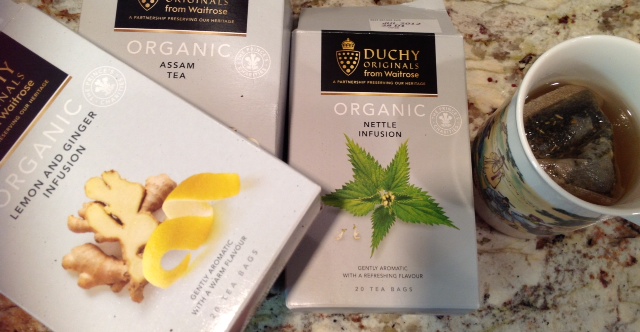
These Duchy tea boxes are a recent leftover from when my mother and I were in London together only last summer.  I had a fully equipped flat for two weeks so I confidently picked three teas thinking I'd chug unnatural amounts of tea at breakfast and bedtime British style but these teas went untouched for many reasons.

Nettle tea is considered a restorative tea chock full of minerals and it tastes mildly awful- like wet dried grass until you get used to it.  Long ago, one of our friends used to harvest nettle from the sides of roads to make pasta.  Nettle is stinging and one really has to be careful not to get any of the fresh stinging hairs on you but it's made safe by cooking.  I wouldn't bother drinking nettle tea without the reputed health benefits and my bones do feel a glow of extra mineral fortification with each sip.  I  can't even say if this Duchy tea is a superior or subpar example of nettle tea but the ginger and organic Assam are forgettable teas.  I have a pathological aversion to throwing any tea away and probably I'll drink these on my visit for another five years.

Under a pile of newspapers in the kitchen table, I was shocked to find a flattened unopened bag of mugwort loose leaf tea I had gifted my mother five years ago.  This mountain mugwort was collected by a friend of a friend's mother. Koreans use mugwort as a flavoring and coloring agent for desserts and I love the taste of green mugwort mochi.  I brewed the mugwort tea for my father tonight and found this inadvertently aged tea still soothing.  Back home in Berkeley, mugwort is often my bedtime replacement for chamomile.

Mugwort has some entertaining folk names- "felon herb", "naughty man", "old uncle Henry" and "sailor's tobacco".   While hiking in Richmond, I found a gangly plant which had striking resemblance to "old uncle Henry" but my husband emphatically convinced me not to put this "felon herb" in my mouth to test if it indeed was the "sailor's tobacco".  Wild crafting has it's risks and I guess risking poisoning or a stomach ache might never be worth a wager.

Tuesday, May 24, 2016

India Black Teas

Egads! What am I doing with 70 samples of India teas?   For various pathological reasons, I have been drinking a lot of subpar bagged English blends in the morning.  I fell into a strange dichotomy. Whereas I will spend some serious mental energy selecting, brewing, obsessing over China teas,  I treat India teas as a basic commodity like milk that I grab off the supermarket shelves.

I cannot reliably start the day without a dark tea- my brain needs something uncomplicated and strong to wake up.  China hongchas (imperial dianhongs, lapsang souchong), shus and darker roasted yanchas and oolongs have become too mentally stimulating on a weekday and so I have reverted to India black teas as my morning workhorse tea.   I'm not trying to overturn my sinophile bias but I want to put a moderate amount of effort finding a supplier in India for higher quality leaf.

Drinking ageable China teas like puerh reflexively engage my prefrontal cortex from early conditioning. For the first few years of drinking puerh, most sessions became a fatiguing and somewhat frustrating exercise in long term planning. My mind was constantly evaluating aging/hoarding potential of a tea. Even if I want to, it's nigh impossible now to turn my analytical brain off with such teas.  But for India teas, I am blissfully immune.  Pretty good India teas are readily available so I just drink it and enjoy.  

I have been recently trying to avoid decision fatigue in the morning in an attempt to simplify my life.  Our decision making ability deteriorates with each choice made throughout the day regardless of importance and you don't want to blow your cartridge too early on inconsequential matters.  My husband wisely has only two different kinds of socks while yours truly considers socks an integral part of a fully color coordinated outfit and hence I make terrible late night purchasing decisions. A box of 70 tea choices could potentially wreak havoc.  However I find that because I am laid back about India teas,  I randomly pick something and am generally satisfied.  I just keep a booklet of gold stars and smiley stickers in the box to keep track of which teas stood out.

I had planned to try out a different India based vendor like teabox but got lazy and went again with Vahdam/Golden Tips as they carry a much larger selection of samplers.   In my second order, I got the summer flush sampler,  Assam party pack,  a chai sampler, various Earl Greys, and some Nilgiri.  The experience has been an altogether a pleasant way to drop a hundo- and really you could not get this kind of variety and quality with China teas for a hundred.


Egads! What am I doing with a mass produced slip-cast teapot lithographed with songbirds? It's probably a few decades too early for me to be going in this direction.  One late ebay night,  I found this English Heron Cross teapot for my husband to commemorate a pair of wrens nesting in our backyard. I excitedly mistook a mating pair of thrushes illustrated on the bottom to be wrens. Even with this misidentification, the husband (a bird lover) could not help but approve this pot after an obligatory interrogation on why we needed another pot.  

Monday, March 07, 2022

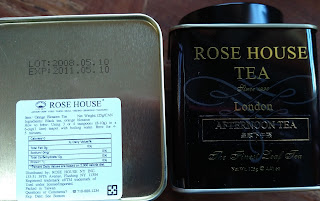
Mystery of 2008 Rose House Tea

 My mother received two canisters of loose black tea for Christmas last year which she dutifully handed over to me. To my very surprise, the expiration date was 2011, the tea being from May of 2008.


What's the chance that this kind of inadvertent black tea aging experiment would land on my very lap. The fact that someone hoarded(?) and re-gifted this tea 14 years later boggles my mind. The gift came from a kindly professor in his eighties who had recently moved.  Despite my burning curiosity, my mother declined to get more information about how long this tea had been in his possession or if it was part of a long chain of regifting. It could be that if you have that many decades under your belt, a single decade feels like a year.

The tea is not spit out disgusting but fairly drinkable. I've had much much worse at museum shops and on airplanes. The underlying blended black tea is still bright. Unfortunately, it's the rancid botanicals(orange blossom, rose petals) that ruin the flavor. Otherwise, I could have happily drunk this decade expired tea without trouble.

What to do? Order another boatload of Assam from teabox.

Saturday, October 21, 2017

Rebooting with Hongchas

The Northern California weather gets nippier every morning demanding a dark vigorous brew.  I have almost pried myself away from the seductions of coffee having my last hurrah at Yosemite.  It was really the full cream and the airy microfoam on cappucino that sustained my addiction and so I must cut this inflammatory dairy cord and return back to tealand.  Most importantly, sustaining such high dosages of caffeine in the blood stream has knocked down my deep sleep so I've amassed more than a few health reasons to cut the bean.

I need a morning replacement that is dark, robust and NOT shu. (Well I shu on weekend mornings but work weekdays require something more mediated than the raw power of shu. Otherwise I get aggro and forget to be diplomatic during technical reviews.) My morning habit was hongcha for decades before this coffee detour and so I return to this familiar ritual of swishing hot water around dark leaves.

Where to procure decent quality hongcha (Indian, Chinese or otherwise) for daily use that is not too fancy but better than average?  My last 2 orders of darjeelings direct from India was a slight flop as the first flushes were just too light/white and delicate for morning use.  I use a pinch here and there in my afternoon blends but my kitchen cabinet is still overflowing with those sample bags.   The solution to too much tea is of course more tea.

15 years ago, I remember my brother in law had gifted me some pretty good tins from Upton Tea. But since I had moved onto puerh and ordering direct from China, I never ordered from them.  For the price less than my last parking ticket, I happily sent out for dozens of samples.  My husband wryly commented, "There is something so deja vu about mylar bags stuffed in a box."   In reality, I could have held out the year comfortably with my home supply of Yunnan dianhong and Lapsang Souchong but I wanted to give myself some more encouragement to choose tea over coffee in the mornings.


No disrespect to hongcha, but novelty in hongchas for the long time tea drinker does not stray far from a narrow band of familiarity. Nothing explosive or life changing, just pleasant diversions in more of the almost same. But that's exactly what I need in the mornings- one can't overstimulate the brain so early without consequences. Their Earl Greys are very respectable and I can see ordering from them regularly for hongcha.  Truth be told, I thought I would be drinking my own aged shengs by now but I am to wait out a few more decades.  In the meanwhile I quietly imbibe some juicy keemuns and assam blends without any second thoughts of coffee.


Saturday, March 11, 2006

TGFOP Assam

While picking up Victor's cake at Crixa, I casually threw in a canister of tea. What a fine brew. I happily sat and had a cup with the moist dark gingery ginger cake made- the kind made with fresh ginger root. So smooth, no bitterness at all even when oversteeped.

I go manically from praising this tea to cursing it for not being able to stand up to a cookie.