Tuesday, July 10, 2012

Cacao Break

Tea drinking and tea thinking has been more stressful for me than needed lately so I thought I would take a break tonight and write about simpler tasting pleasures which must strictly be enjoyed in the present. With tasting sheng,  one inevitably thinks past the present to how your future self will enjoy the future aged state of a sheng.  One's brain can get tied up in knots.

Every other week I buy stacks of dark chocolate ranging from 75% to 88% cacao.  Normally I buy the usual suspects- single origin bars that are surprisingly good for being three to five dollars.  Sigh. Back in 2003 - 2004 before my first pu-erh craze, I used to regularly enjoy the king of chocolates Chuao and the queen- the ever delicate and ever floral Porcelana from a Tuscan outfit called Amedei. Just like Chen Sheng Tea Factory in LBZ,  Amedei wrought exclusive control over beans from Chuao -a coastal town in Venezuela.  Amedei successfully kicked french chocolate maker Valrhona out of Chuao in a rather nasty price war pushing Chuao beans to a world record $9 a kilo from $1.5 per kilo.  Of course Amedei easily passes this surcharge onto the ever-willing end consumer.  For a decade now I have been satisfying myself with what I can find in the neighborhood markets.  To be fair, Berkeley supermarkets carry a most respectable gift-worthy selection of dark chocolates and no one need be ashamed of consuming such solidly produced chocolate bars. 
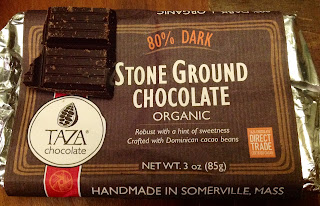
Out of the six bars this week, the clear winner was the odd bar out- the Taza 80% which exploded in my mouth full of jammy fruity high notes.  Unlike all other Western chocolate bar makers,  Taza does not conch their chocolate.  Conching is a process where by you slowly beat the crap out of the cacao paste to give the resulting chocolate a silky texture. But this process generates heat which also mellows out the paste by removing the acetic acid left over from less than perfect bean fermentation.  Italian bars from Cuba Venchi are incredibly low acid nutty productions with a silky smooth texture because they conch more than 72 hours where as mass producer Hershey's will conch for 12 hours but compensate for poor bean quality with diabetic amounts of sugar.  Just as in puerh, there are many industry post-processing and manipulation tricks to cover up any flaws of the source material.  

In order to skip conching, you really need the highest levels of bean quality. While the texture of Taza bars are gritty,  they preserve the original fruity taste of the bean.  The ancient Maya certainly never conched and we're lucky an American bean-to-bar producer took the more difficult road to produce such a chocolate bar.  I rarely eat more than a few squares of any bar leaving the rest for my husband but you can see that I had to control myself to leave two squares to enjoy tomorrow.

When a shu is rather ho-hum, I  enjoy it with a good dark chocolate bar and sometimes a few bacon bits to great effect. When a chocolate bar is ho-hum, I just make hot chocolate out of it.  Bad bars don't hang around for years taunting me with it's plantation mediocrity highlighting my bad selection prowess. I'd like to stabilize my pu-erh collecting and drinking to where I enjoy moderately good teas for daily drinking and save special cakes for special occasions.   But I still have a steep steep sheng tasting curve to overcome.

Waiting for Wuliang Part I


In 2007,  I ordered a Wuliang beeng.  Due to an unfortunate mix-up which was half my fault, I instead received a beeng from a neighboring mountain.  Thus I was transported unwillingly to Mournful Prison Mountain(Ailuo 哀牢山) instead of ascending Limitless Mountain(Wuliang 无量山). Thanks to Hobbes and Jason Cohen for the translations. Perhaps this mix-up was the last straw that broke the camel's back but I did not buy any more pu-erh for 6 years.

To right this wrong, I finally bought two pure Wuliang shengs produced by Yunnan Sourcing, the 2010 beeng from YS-US and the 2012 version from YS Kunming. I also had started on the road to Birthday Beeng selection with Jakub's recommendation of enthrallment- the 2010 HLH Yiwu among many other fun samples to be revealed later.  Today while I was at work, my husband e-mailed me a photo of a box from Kunming Post.  I was shocked to receive Scott's order in a record 4 days! It cost $36 express shipping but still I'm impressed. 

Wuliang is a sizable mountain range bordering Dali and Lincang so Wuliang teas must surely show up elsewhere.  I may have been unknowingly quaffing Wu Liang brews all along as Xiaguan uses materials from Wuliang Shan as does (or did) Nan Jian Factory.  The 07 Xiaguan "FT" #4 is comprised of Wuliang and Bao Shan leaves while the 08 XY 8853 is all spring Wuliang and Lincang leaves.  I vowed no more Xiaguan buying for me in 2006 so I only got the Nan Jian pure Wuliang mini-bricks for doing the big factory comparison.

Scott's YS cakes are made of leaves from the remote Zhong Cang village (中仓村).  Further web research with the google translator indicates that Zhong Cang villagers grow tobacco and walnuts as well as slaughter 1300 hogs a year.  In 2006, the village had a total of one car, three tractors, and 44 motorcycles.  I could only find the following pictures of Zhong Cang village tea trees on the provided link which may or may not have any correlation to Scott's beengs which are advertised to be from 200 year old trees.  Google maps indicate a fairly heavy agricultural use of the village lands.


Sunday I brewed up the 2010 Wuliang to enjoy a moment of pre-dinner contemplation.  The cake includes the bonus of a tiny rough twig and a few grain husks.  My first two quick rinses were  strongly yellow.   I couldn't stop sipping because I really really miss drinking sheng - this tea has a subtle bitterness which is perfect for remembrance.  The youthful astringency reaches all the way down my chest and I had to clutch my collarbone all the while drinking this tea.  My mouth is continually salivating with sweetness.

I tried to decode the sensations to visualize shapes and colors. But instead I hear the muted low notes of a vibraphone.  The fifth infusion becomes intensely sweet- more sugarcane than honey and I start gulping it down rather greedily.   I'm enjoying myself head to throat while everything below is burning. Part of me is wondering if my foray into shengs is now progressively worsening my intolerance. Today when sniffing the 2012 shengs, I could feel the astringency in my gullet. My husband shakes his head whenever he sees me crazy eyed looking at my shengs. I think I will risk tasting the 2012 version this weekend.

Sunday, July 08, 2012

Red Violin of Puerh

I spent some lovely stretches on my swing finally catching upon summer reading.  The most enjoyable of the batch was the "Billionaire's Vinegar" - a non-fiction mystery about the scandal filled world of rare aged wines which was entirely applicable to the similarly murky world of aged pu-erh.   The title comes from a misrouted bottle of a 1787 Lafite supposedly ordered by my FFF Thomas Jefferson. Infamous wine collector Hardy Rodenstock "found" this bottle amongst other wine gems perfectly sealed up within the walls of an undisclosed Paris apartment during demolition.  The Forbes family bought this particular bottle via Christie's for $150,000 and stored it proudly under a toasty halogen light along with their other presidential memorabilia.  An employee with sharp eyes found the shrunken cork floating in the world's most expensive wine.  Forbes had never meant to drink this wine but bought it to own a piece of American history.  But did this wine really belong to Jefferson?  Was this wine even from 1787?

Only if someone would write a pu-erh page turner a la the"Red Violin".  Perhaps it could be about this 1895 imperial golden melon featured in this pu-erh documentary. You may desire to skip straight to the scene starting 7:42).


The author could interweave at least a century of Chinese history from the decline of the Qing all the way to the rampant capitalist China of today. The author could lard the story generously with useful details of puerh manufacture for types like us.  Maybe the author can exploit the inevitable switzeroo  plot device twice, once during the Cultural revolution and then a second time during the pu-erh boom years to multiple black market buyers one of whom could be Russian(or Bulgarian) mafiosi with a Chinese girlfriend.  (Video spoiler alert- were you as crestfallen as I was upon hearing that this golden melon was stored underground and had some "insecticide" issues. After that, I definitely agreed that "we dare not covet the emperor's golden melon."  )

Back to the original book review- the most unfortunate and glaring parallel between the world of aged wine and aged pu-erh revolve around rampant forgery and the suckers who fall for them.  Most commonly it wasn't oenophiles(a.k.a. serious wine drinkers) but rich people with too much money that would pony up for these outrageously priced aged wines to display in a trophy collection. (I also was scratching my head for the proper term for pu-erh lovers- puerhophiles? We have to be very careful with the spelling since "puer" could be mistakenly interpreted in an ancient Greek direction.  A bit dorkier but magnafoliophile is definitely a safer way to go but my latin is completely rusty so if someone could suggest something more elegant.)  

By the time someone does open a bottle and find it undrinkable,  most people don't know enough about aged wines to deem it a fake and may just blame bad storage conditions.  But just suggestion and price tag alone sometimes would convince drinkers the authenticity of a bottle.  Those who knew enough to find themselves had,  they cannot prove conclusively that a wine was fake or it may be too late to catch up with the original perpetrator in a long chain of middle-men spanning the centuries.  According to this book,  even the venerable auction houses Sotheby's and Christies were well aware of fakes exploding in the market place, but they were only too happy to be party to the commissions generated by such a lucrative market. 

For me, one of the most useful nuggets was the lack of a conclusive scientific method to date wines older than 65 years.  Scientists can measure the presence of radioactive compounds to determine that a wine predates the atomic age. Wines after 1945 hold certain levels of decaying tritium or cesium-137 which match against a time curve.  Probably there is a new curve which goes against Chernobyl and now Fukushima. Unfortunately such tests are the foray of hyper-expensive labs; a home Geiger counter simply will not cut it. 

Thursday, July 05, 2012

July Fourth Tea - 05 Yiwu Bamboo

Early in my buying days, I tended to be attracted to the novelty subgenre of puerh- stuffed pomelos, stuffed bamboos and their ilk.  Was it subpar tea made more palatable and marketable by a gimmick like the strawberry papaya popcorn white tea or are these fringe pu-erhs something unique to be treasured?

This here fat tube of bamboo stuffed sheng was advertised as 2005 Yi Wu Mountain Bamboo. The processing is similar to the "Dai Tribe" sheng that YS sells where maocha is steam stuffed into giant bamboo stalks and roasted vertically in small fire pits. The final tea is dried for a few days, then removed from the charred stalks and repackaged into bamboo husks. Despite this trial by fire, the tea has no smoky smell and you have to squint to spot the very few black dots as evidence of the charring.  (Makes you wonder how HLH can get so many crisp burnt edges on such expensive cakes.)


Unlike my other thinner Xiang Zhu stuffed examples where the leaves are more forcefully jammed and crammed in, I can tell a more careful loving hand-stuffing was practiced. (Perhaps the compression style varies by the stuffer's personality. )  I can easily pry out a nice chunk just by wiggling a long stem.  My mouth waters looking at such full and dark furry leaves. I  have the rare pleasure of easily removing sections to see that the aging on the outside of the tube is noticeably different (darker more matte and dry) from the golden sheen of leaves inside.  I really should be preparing my cheese and fruit platter for the neighborhood Fourth of July BBQ potluck but instead here I am sniffing and brewing.  There is something ridiculous about writing a blog about a tea that you can't drink. It's like a lactose intolerant Asian keeping a blog about milkshakes. (Actually that was me...)

I call my closest surrogate tastebuds into action. The husband is really into it. He digs the mineral seaweed profiles likening it to oysters.  Is this the subtle aromatics described most commonly as "unique" from being steamed in a bamboo?  I hazard only a few sips. It's a mildly rough concoction, subsequent brews taste stimulating and drying at the same time.  I doubt it really is Yiwu for $13 per half a kilo but it's an enjoyable afternoon session. 

I pop out to my bamboo patch and cut a few stalks to get a whiff of the bamboo smell.    My common bamboo (a poor poor cousin to the Yunnan aromatic bamboo) smells quite unremarkable like fresh cut grass.  Koreans had a fad of products made from salt stuffed in bamboo by Buddhist monks.  The Korean bamboo toothpaste was altogether reprehensible.  The bamboo bath salt left a weird film requiring a thorough shower afterwards.  Super expensive fragrant bamboo rice was a culinary disappointment.  I would normally recommend against gimmicky bamboo products but this bamboo stuffed tea is a fun diversion to the more civilized paper wrapped sheng experience and the husband likes the flavor profile to boot!


The leaves are unexpectedly lovely due to the long stems and you can see plenty of buds. The brew doesn't reflect a woodiness in the taste and is lighter and more refreshing than expected- probably due to autumn leaves.  I may even try to get the Dai version to compare- I had bought this particular batch even though Scott was selling the Dai version even back then because the Dai version looked gnarlier with older leaves. 

I had planned to drink the more thematically authentic "Hyson" green tea to celebrate July Fourth.  For those who haven't watched Indepenence Day starring Will Smith- July Fourth is when we celebrate our break from our greedy British overlords.   I was explaining this holiday to my colleague in the London satellite office.  He promptly switched this most sensitive topic to the Queen's Jubilee.    It's an oft spoken truism that the British turned Americans into a nation of coffee drinkers with unsustainable taxation.  Tea probably will never overturn coffee's favored status here but for those like me who are entirely hooked on Chinese tea, I am ever grateful I even have access to these weird fringe varieties of pu-erh. 

Tuesday, July 03, 2012

Evicting Sheng Duds

In the next two weeks, an immoderate amount of tea is to arrive at my doorstep.   I need to serve eviction notices for cakes which do not hold my favor.  The pickier part of me says I should start swapping out with more stellar examples of their genre but the retentive part of me has all sorts of creative reasons not to let go.

What are these despised duds wantonly taking up precious tea real estate?  

Back in early 2006, I saw the 2004 Changtai 16 Cake Set for a ridiculously dirt cheap price (~$80). I asked my husband if I should buy it as a learning tool and he said to me without any sense of future irony, "Hmmm. That's a lot of tea. What are you going to do with that much tea!" So I didn't get it and then it promptly sold out.


This 2 kilo 4 beeng Xiaguan Big G Set was the rebound purchase.  As you can imagine, it really did not make me feel better. I know the 2004 Changtai tasting set came under scrutiny and accusations flew that some cakes were not truly single origin due to lax oversight but I don't think I would have regretted that purchase- definitely not for $80.  Changtai beengs are sometimes known to have a wee bit extra oxidation but still, I would of had a lot more fun with that set than this Big G one which the vendor description indicates is all the same blend.   All same inside. All same (head hung low...)

"The four cakes are all the same blend of leaf: Orange Wrapper - Xiaguan Feng (Xiaguan Wind) Blue Wrapper - Er Hai Yue (Er Hai Lake Moon) Red Wrapper - Shangguan Hua (Shangguan Flower) Green Wrapper - Cangshan Xue (Cangshan Snow)"

Cangshan is the snow capped mountain range west of Dali with Erhai lake(ear shaped lake) sandwiched in between. Xiaguan is based in Dali and it's all a naming theme with no relation to the tea source. The vendor also described this Xiaguan collector's box as being the best quality Xiaguan produced that year. It has lost that sweet Xiaguan spring tea smell leaving that signature Xiaguan smoky leathery fragrance.  


For the first time in my life, I am able to break a Xiaguan product with by bare hands. I'm going to optimistically claim victory in Berkeley aging. My husband brewed it up tonight for the first time in 7 years and I am breathtakingly awaiting a report.  


Every collection must include some Xiaguan if not for reference and what's wrong with this best Xiaguan?  Every time I look at this box I sigh.  The ChangTai that got away caused me to overcompensate and buy all sorts of subsequent tea I should not have.  These 2003 Xiaguans are not a dud because there is something inherently wrong with them besides the chopped plantation leaves.  They just give me pangs and twinges of collector's remorse that I can't seem to dispel.

Second up is the 2005 6 FTM Yinji Series.  A friend moving back from Beijing proudly and cheerfully exclaimed on 7 cakes bundled in a bamboo basket(Ban Zhang, Yi Wu, You Le, Bang Wei, Nan Nuo,Yi Bang plus bonus Spring Cake), "Can you believe it! This was only $20!"  Yinji or "Spirit of XXX" series is 6FTM's lowest entry level offering which blends a very small percentage of mountain in question.   I desperately wish I had just wired some money to her but it's tricky letting a non-puerh drinker to buy pu-erh at Meliandao. I am hugely grateful she brought some pretty nice Doujis as well.

I was rereading Ethan Thompson's 26 Mountains, Fifty Cakes on the Leaf. He reviews the instructive Jing Mei Tang 50 Cake Set which he contrasts to his Changtai set. Ethan talks about "market-floor garbage" and "garbage cakes". I'm pretty sure at least this pile of 6FTMs could be a poster child for  "market-floor garbage".  But is this any reason to kick these poor cakes to the door especially since they came into the house as gifts.  I actually have never cracked open any of these FTMs because I always had better to drink.  


More and more,  I'm coming to the conclusion that factory plantation teas have a time and a place in my collection. While one shouldn't go out of their way to fill out a collection with them, if they happen to already be part of your collection, there are many good reasons to keep them around. Here are my top 5 reasons to keep my early mistakes:

1. I apparently like cheap tea.

I've been enjoying aged cheap quality shu recently. Even though I am forced to pay dearly for them now, those bricks must have been a few yuans back in the day with leaf quality to match. You can only imagine the hygiene of communist tea factory floors.   (Probably better if you don't).

All my dud cakes are much higher leaf quality than those filthy bricks and will probably end up being as good as or if not better than those shus.

2. Reference tea. You need big factory teas to make you really appreciate your small batch artisanal teas.

It's good to have special teas for special occasions. The single mountain teas tend to require attentiveness. I don't want to be drinking high end single varietals all the time because some days you just need a tea to get the job done.  

3. I need aging sheng to give away to beginner drinkers who need to broaden their palates with these kinds of factory offerings.

4. I need experimentation material.
I need ready material I'm willing to use for experiments with aging.  Why buy new when there is already this available supply.

5.  These guys have been aging with me and are part of the tea family.
Sounds ridiculous I know and such sentiments are common to those who exhibit hoarding symptoms. These teas have been with me for some of the hardest years of my life and the bitterness in life is best swallowed in tea.

And so you can see with logic like this, I have never evicted any cake from my collection.