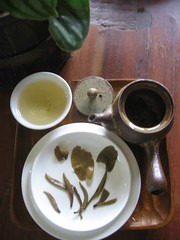
At the end of 2005, I was bitten with a pu-erh mania(only in a small way compared to others) and for the following two years I spent a great part of my free time obsessing over sheng pu-erh. The fascination for me was the complexity and range of flavors one could find in the endless brewings of young sheng. I was hooked by the different physiological effects sheng had on my mental state and I was really chasing beengs that would bring me the greatest mental clarity.
But then sadly after two years, drinking sheng took a toll on my system and my stomach could no longer take the strength of sheng. I was relegated to the ho-hum world of cooked puerh. It's hard to get off on tasting just shu so I took a hiatus from the mysterious world of pu-erh and woefully drunk a little shu from time to time.
My sheng collection of about 60 cakes has been quietly resting in my tea closet for the last 7 years. I have been using my ipad recently to organize and manage the state of my collection. But in sampling my oldest cakes after five years of hiatus, I now wonder if I should give up home aging altogether. My 2002/2003 cakes still brew light with noticeable astringency- my stomach still complains that even my decade old cakes are nowhere near ready to be enjoyed. Too cold, not humid enough with relative humidity fluctuating between 40 to 60%, the Bay Area is "extra-dry" storage. I fear that the dryness could actually be damaging the cakes. But the thought of giving up makes me too sad so I vow to give it another decade or two.
When I was building up my collection 6 years ago, I really knew nothing about pu-erh and I still know very little about it despite having spent thousands of hours drinking, reading, shopping for pu-erh. Now after my hiatus, I write the following reflections to guide my second phase of pu-erh appreciation and you can see I'm still confused and any clarification would be greatly appreciated.
Enjoying the Tea
It's not uncommon that pu-erh tea drinkers spend more time in ancillary activities surrounding pu-erh (internet research, buying, micromanaging stash, staging and photographing brew sessions, blogging) than actually drinking the stuff. Pu-erh provides the pure sensual pleasures of the brew as well as an endless complexity for the mind but I wish I had spent more time simply enjoying the tea rather than over-analyzing every brew. I agree there is pleasure in the analysis but there is definitely more room for pleasure without over-thinking.
Depth vs Breadth
During the phase I was building up my collection, very few vendors were offering samples so I had no choice but to buy whole beengs and hope for the best. I never invested in tongs because trying different teas to expand my palate was more important to me than investing in something I already knew I liked. Also who knew how the flavors of a cake would change over time. Even though the specific types which intrigued me most were Nannuo and DeHong purple leaf, I still kept buying different mountains, different factories constantly looking for something I would enjoy more.
Because many experts had stated that strong teas age best, I went for a few Banzhang beengs although I question if some of them really are pure Lao Banzhang. Hai Lang Hao definitely must be pure Banzhang as it lives up to the "rocket fuel" designation where as the Douji Banzhang feels too muted to be a Banzhang. No one really knows how single mountain cakes will age since most cakes in the 20th century were blended. Perhaps diversification might prove to be the best strategy in the end because no one really knows what will age best. I'll just have to get back to you in another 10-20 years. Maybe most of my cakes will be totally weak-assed. But really, even if a few cakes out of 60 end up being winners, I'll be happy. And if most of my cakes age into something flat and very boring, I will just stick a few young sheng leaves to liven things up. It's good to have low expectations so you may be pleasantly surprised.
The one aspect I love about pu-erh is that these cakes are slowly aging with me and we've already gone through some tough years together. It's not only that your sheng will age in ways you can't predict but your own palate may change as well. You do not know that you might not like the mushroomy earthy flavor twenty years from now or you might find camphor notes unpalatable. But then again, you may start enjoying those flavors in another decade of your life. I think these cakes have better potential than that wooly sweater in the closet you never wear but may come back into fashion some day.
Compression
I really really should have preferred stone compressed over hydraulic. I had read that iron cakes age better and so I bought mostly iron cakes but this advice may be for wetter regions like Hong Kong. Since I live in a non-humid climate of the Bay Area, looser compression definitely was the way to go. My stone cakes(from Douji, Changtai, Fo Cha Ji) appear to have aged somewhat faster than my iron cakes. The second reason to prefer stone compression is much more practical- sampling from iron cakes is just too painful and broken leaves unavoidable. But most importantly, stone compressed cakes tend to be made by smaller outfits and this preference alone would have helped me avoid mediocre cakes from the giant factories. I have no shortage of of Haiwan, Xiaguan, 6 FTM cakes I'd rather not have bought but big factory cakes were what was most available to me at the early stages of my collecting. Really I resisted buying a Haiwan Lao Tong Zhi for a very long time but the more I saw them everywhere the more I felt obligated to have one just for reference.
Ancient Tree vs. Wild Tree vs. Plantation
Universal wisdom is that non-plantation leaves taste more complex and age better so I did try to find cakes which were purported to be Wild Arbor, gushu, or qiaomu. Even advice this simple leaves me at a loss because I've also read in the First Step to Puerh that the cakes from the Communist times(Hong Yin and Lan Yin) are purported to be only plantation leaves.
I have no way of knowing what percentage of a cake labeled "Wild Arbor" really is "old" and then there is the quality of the old tree leaves to contend with. Do big factories such as XiaGuan, Haiwan, and 6FTM which have premium cakes labeled Old Tree use a lesser grade old tree than smaller productions even if the price is same or higher? Are inferior old tree leaves still to be preferred over top quality plantation? Will pure wild tree really age better than a blend? Answers! Answers! My noodle is still all bent out of shape because I can't seem to grasp onto any truth in this endlessly fascinating topic.
Avoiding Western Middlemen
There is one aspect of pu-erh collecting that I am 100% certain of and that is to avoid paying unnecessary middlemen. One can pay a very serious premium for buying pu-erh from a Western vendor. I think the hefty premium is warranted if they have a teashop that let's you sample before purchasing a $50+ cake. My biggest purchase regrets come from buying from U.S. vendors over the internet for really over-priced uninteresting pu-erh but this was before I knew you could even buy direct from China. My "tuition" was under $300 but I get a little grumpy whenever I see my overpriced tribute melon or my infamous cigarette beeng- sometimes I feel like it's better I just give my mistakes away altogether to get rid of this bad karma. The said melon is from 2004, maybe it's now at the correct price. Nah, even now this little melon is way way overpriced and smells like a cigarette- the vendors had such a lovely helpful website...
Sharing and Community
The one aspect I loved about pu-erh was the fantastic virtual community of tea drinkers. In 2007, bearsbearsbears brilliantly hosted a LiveJournal mail-in tea tasting to which I was lucky to be part of. I wonder if all the original members are still actively pursuing pu-erh, I know some of them stopped blogging because life happens and it really takes fortitude, dedication, and free time to be blogging about tea. I still have an unopened stash of the Mandarin's vacuum sealed tea which I purposefully did not open because I was curious about the effects of aging under a completely sealed environment. I still have enough of the samples left so perhaps I can get the old gang together to do an aging comparison!
But then sadly after two years, drinking sheng took a toll on my system and my stomach could no longer take the strength of sheng. I was relegated to the ho-hum world of cooked puerh. It's hard to get off on tasting just shu so I took a hiatus from the mysterious world of pu-erh and woefully drunk a little shu from time to time.
My sheng collection of about 60 cakes has been quietly resting in my tea closet for the last 7 years. I have been using my ipad recently to organize and manage the state of my collection. But in sampling my oldest cakes after five years of hiatus, I now wonder if I should give up home aging altogether. My 2002/2003 cakes still brew light with noticeable astringency- my stomach still complains that even my decade old cakes are nowhere near ready to be enjoyed. Too cold, not humid enough with relative humidity fluctuating between 40 to 60%, the Bay Area is "extra-dry" storage. I fear that the dryness could actually be damaging the cakes. But the thought of giving up makes me too sad so I vow to give it another decade or two.
When I was building up my collection 6 years ago, I really knew nothing about pu-erh and I still know very little about it despite having spent thousands of hours drinking, reading, shopping for pu-erh. Now after my hiatus, I write the following reflections to guide my second phase of pu-erh appreciation and you can see I'm still confused and any clarification would be greatly appreciated.
Enjoying the Tea
It's not uncommon that pu-erh tea drinkers spend more time in ancillary activities surrounding pu-erh (internet research, buying, micromanaging stash, staging and photographing brew sessions, blogging) than actually drinking the stuff. Pu-erh provides the pure sensual pleasures of the brew as well as an endless complexity for the mind but I wish I had spent more time simply enjoying the tea rather than over-analyzing every brew. I agree there is pleasure in the analysis but there is definitely more room for pleasure without over-thinking.
Depth vs Breadth
During the phase I was building up my collection, very few vendors were offering samples so I had no choice but to buy whole beengs and hope for the best. I never invested in tongs because trying different teas to expand my palate was more important to me than investing in something I already knew I liked. Also who knew how the flavors of a cake would change over time. Even though the specific types which intrigued me most were Nannuo and DeHong purple leaf, I still kept buying different mountains, different factories constantly looking for something I would enjoy more.
Because many experts had stated that strong teas age best, I went for a few Banzhang beengs although I question if some of them really are pure Lao Banzhang. Hai Lang Hao definitely must be pure Banzhang as it lives up to the "rocket fuel" designation where as the Douji Banzhang feels too muted to be a Banzhang. No one really knows how single mountain cakes will age since most cakes in the 20th century were blended. Perhaps diversification might prove to be the best strategy in the end because no one really knows what will age best. I'll just have to get back to you in another 10-20 years. Maybe most of my cakes will be totally weak-assed. But really, even if a few cakes out of 60 end up being winners, I'll be happy. And if most of my cakes age into something flat and very boring, I will just stick a few young sheng leaves to liven things up. It's good to have low expectations so you may be pleasantly surprised.
The one aspect I love about pu-erh is that these cakes are slowly aging with me and we've already gone through some tough years together. It's not only that your sheng will age in ways you can't predict but your own palate may change as well. You do not know that you might not like the mushroomy earthy flavor twenty years from now or you might find camphor notes unpalatable. But then again, you may start enjoying those flavors in another decade of your life. I think these cakes have better potential than that wooly sweater in the closet you never wear but may come back into fashion some day.
Compression
I really really should have preferred stone compressed over hydraulic. I had read that iron cakes age better and so I bought mostly iron cakes but this advice may be for wetter regions like Hong Kong. Since I live in a non-humid climate of the Bay Area, looser compression definitely was the way to go. My stone cakes(from Douji, Changtai, Fo Cha Ji) appear to have aged somewhat faster than my iron cakes. The second reason to prefer stone compression is much more practical- sampling from iron cakes is just too painful and broken leaves unavoidable. But most importantly, stone compressed cakes tend to be made by smaller outfits and this preference alone would have helped me avoid mediocre cakes from the giant factories. I have no shortage of of Haiwan, Xiaguan, 6 FTM cakes I'd rather not have bought but big factory cakes were what was most available to me at the early stages of my collecting. Really I resisted buying a Haiwan Lao Tong Zhi for a very long time but the more I saw them everywhere the more I felt obligated to have one just for reference.
Ancient Tree vs. Wild Tree vs. Plantation
Universal wisdom is that non-plantation leaves taste more complex and age better so I did try to find cakes which were purported to be Wild Arbor, gushu, or qiaomu. Even advice this simple leaves me at a loss because I've also read in the First Step to Puerh that the cakes from the Communist times(Hong Yin and Lan Yin) are purported to be only plantation leaves.
I have no way of knowing what percentage of a cake labeled "Wild Arbor" really is "old" and then there is the quality of the old tree leaves to contend with. Do big factories such as XiaGuan, Haiwan, and 6FTM which have premium cakes labeled Old Tree use a lesser grade old tree than smaller productions even if the price is same or higher? Are inferior old tree leaves still to be preferred over top quality plantation? Will pure wild tree really age better than a blend? Answers! Answers! My noodle is still all bent out of shape because I can't seem to grasp onto any truth in this endlessly fascinating topic.
Avoiding Western Middlemen
There is one aspect of pu-erh collecting that I am 100% certain of and that is to avoid paying unnecessary middlemen. One can pay a very serious premium for buying pu-erh from a Western vendor. I think the hefty premium is warranted if they have a teashop that let's you sample before purchasing a $50+ cake. My biggest purchase regrets come from buying from U.S. vendors over the internet for really over-priced uninteresting pu-erh but this was before I knew you could even buy direct from China. My "tuition" was under $300 but I get a little grumpy whenever I see my overpriced tribute melon or my infamous cigarette beeng- sometimes I feel like it's better I just give my mistakes away altogether to get rid of this bad karma. The said melon is from 2004, maybe it's now at the correct price. Nah, even now this little melon is way way overpriced and smells like a cigarette- the vendors had such a lovely helpful website...
Sharing and Community
The one aspect I loved about pu-erh was the fantastic virtual community of tea drinkers. In 2007, bearsbearsbears brilliantly hosted a LiveJournal mail-in tea tasting to which I was lucky to be part of. I wonder if all the original members are still actively pursuing pu-erh, I know some of them stopped blogging because life happens and it really takes fortitude, dedication, and free time to be blogging about tea. I still have an unopened stash of the Mandarin's vacuum sealed tea which I purposefully did not open because I was curious about the effects of aging under a completely sealed environment. I still have enough of the samples left so perhaps I can get the old gang together to do an aging comparison!