Showing posts with label sheng. Show all posts

Friday, October 17, 2014

Dry 2001 7542 vs the Lucifuge 90s CNNP

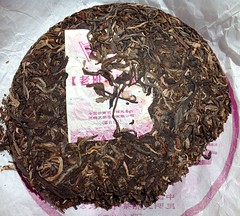
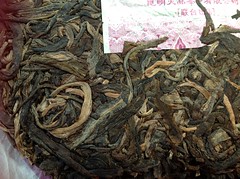
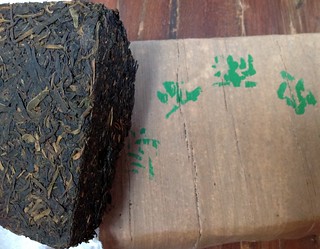
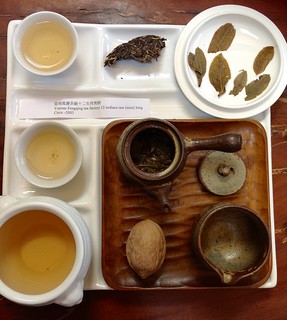
To ease my mind from encroaching ebola fears, I thought I would take my diversion in tea this afternoon.  Up first is a random CNNP brick from ebay.    You can see there is generous white frost on the surface and stems inside. After all my adventures in mold, I actually did not bat an eyelash when I opened this brick. The storage of this brick was advertised as:
"Clean, Ventilating, Lucifuge, Dry, No Srange Smell And Pollution"

I have some vague notions about what this "Lucifuge" condition is about. To regurgitate wikipedia, lucifuge comes from "lux" latin word for light plus fuigio meaning to flee.  "He who flees the light"!  Lucifuge surely must be storage under dark conditions. But if it also means Lucifuge-the demon in charge of Hell's government oversaw the aging of this cake, I'm down with that too.  Most likely it would have been one of his minions as I'm sure the real Lucifuge is crazy busy with weightier matters.

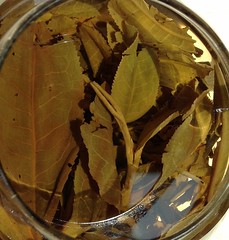
I must have graduated from wet storage 101 because I can drink it without gagging. That is something. The brick must have dried out for many years as it does not smell so bad and the brew is lighter brown so the wet storage was not too overdone.   That moldy shicang flavor has finally grown on me.   I've drunk this tea multiple occasions without ill-effects and I'm curious how such a brick will dry out here in Berkeley. The slightly wet 90s Ding Xing is doing so much better so I'm keen to load up on more slightly wet cakes.

The ebay listing photos did not show any signs of mold so I wrote the vendor who kindly will send me a dryer version.   Is this brick really 15 years old to merit the 90s designation?  At least 8-10 years I would guess and I should get some younger trad stored cakes to compare.


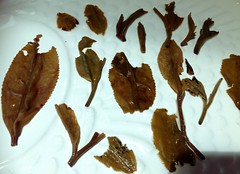
As an antidote, I finally open up the 2001 7542 sample Jakub sent me that started the whole Luke Skywalker dry storage meme.  It's like eating a slice of English cheddar after being assaulted with a ripe morbier.  This 7542 is a pricey chunk of pu from Sampletea and I'm happy he sent it to me instead of another dry storage hater.  I was saving it for a dry vs. super dry comparison but I went for it today.  

Compared to the 2003 7542 MarshalN sent me,  the 2001 version is rather of ho-hum but still a pleasant aged experience. It's not terribly exciting but it's drinkable which is more than what my cakes are now.  But if I had to pay triple digits for something like this now, I would be kind of upset.  I'm glad I didn't splurge on too many expensive shengs back then only to see them hollow out like this.   However if my ten dollar ten year olds start tasting like this in a few years, I would not mind at all.  

Tuesday, July 03, 2012

Evicting Sheng Duds

In the next two weeks, an immoderate amount of tea is to arrive at my doorstep.   I need to serve eviction notices for cakes which do not hold my favor.  The pickier part of me says I should start swapping out with more stellar examples of their genre but the retentive part of me has all sorts of creative reasons not to let go.

What are these despised duds wantonly taking up precious tea real estate?  

Back in early 2006, I saw the 2004 Changtai 16 Cake Set for a ridiculously dirt cheap price (~$80). I asked my husband if I should buy it as a learning tool and he said to me without any sense of future irony, "Hmmm. That's a lot of tea. What are you going to do with that much tea!" So I didn't get it and then it promptly sold out.


This 2 kilo 4 beeng Xiaguan Big G Set was the rebound purchase.  As you can imagine, it really did not make me feel better. I know the 2004 Changtai tasting set came under scrutiny and accusations flew that some cakes were not truly single origin due to lax oversight but I don't think I would have regretted that purchase- definitely not for $80.  Changtai beengs are sometimes known to have a wee bit extra oxidation but still, I would of had a lot more fun with that set than this Big G one which the vendor description indicates is all the same blend.   All same inside. All same (head hung low...)

"The four cakes are all the same blend of leaf: Orange Wrapper - Xiaguan Feng (Xiaguan Wind) Blue Wrapper - Er Hai Yue (Er Hai Lake Moon) Red Wrapper - Shangguan Hua (Shangguan Flower) Green Wrapper - Cangshan Xue (Cangshan Snow)"

Cangshan is the snow capped mountain range west of Dali with Erhai lake(ear shaped lake) sandwiched in between. Xiaguan is based in Dali and it's all a naming theme with no relation to the tea source. The vendor also described this Xiaguan collector's box as being the best quality Xiaguan produced that year. It has lost that sweet Xiaguan spring tea smell leaving that signature Xiaguan smoky leathery fragrance.  


For the first time in my life, I am able to break a Xiaguan product with by bare hands. I'm going to optimistically claim victory in Berkeley aging. My husband brewed it up tonight for the first time in 7 years and I am breathtakingly awaiting a report.  


Every collection must include some Xiaguan if not for reference and what's wrong with this best Xiaguan?  Every time I look at this box I sigh.  The ChangTai that got away caused me to overcompensate and buy all sorts of subsequent tea I should not have.  These 2003 Xiaguans are not a dud because there is something inherently wrong with them besides the chopped plantation leaves.  They just give me pangs and twinges of collector's remorse that I can't seem to dispel.

Second up is the 2005 6 FTM Yinji Series.  A friend moving back from Beijing proudly and cheerfully exclaimed on 7 cakes bundled in a bamboo basket(Ban Zhang, Yi Wu, You Le, Bang Wei, Nan Nuo,Yi Bang plus bonus Spring Cake), "Can you believe it! This was only $20!"  Yinji or "Spirit of XXX" series is 6FTM's lowest entry level offering which blends a very small percentage of mountain in question.   I desperately wish I had just wired some money to her but it's tricky letting a non-puerh drinker to buy pu-erh at Meliandao. I am hugely grateful she brought some pretty nice Doujis as well.

I was rereading Ethan Thompson's 26 Mountains, Fifty Cakes on the Leaf. He reviews the instructive Jing Mei Tang 50 Cake Set which he contrasts to his Changtai set. Ethan talks about "market-floor garbage" and "garbage cakes". I'm pretty sure at least this pile of 6FTMs could be a poster child for  "market-floor garbage".  But is this any reason to kick these poor cakes to the door especially since they came into the house as gifts.  I actually have never cracked open any of these FTMs because I always had better to drink.  


More and more,  I'm coming to the conclusion that factory plantation teas have a time and a place in my collection. While one shouldn't go out of their way to fill out a collection with them, if they happen to already be part of your collection, there are many good reasons to keep them around. Here are my top 5 reasons to keep my early mistakes:

1. I apparently like cheap tea.

I've been enjoying aged cheap quality shu recently. Even though I am forced to pay dearly for them now, those bricks must have been a few yuans back in the day with leaf quality to match. You can only imagine the hygiene of communist tea factory floors.   (Probably better if you don't).

All my dud cakes are much higher leaf quality than those filthy bricks and will probably end up being as good as or if not better than those shus.

2. Reference tea. You need big factory teas to make you really appreciate your small batch artisanal teas.

It's good to have special teas for special occasions. The single mountain teas tend to require attentiveness. I don't want to be drinking high end single varietals all the time because some days you just need a tea to get the job done.  

3. I need aging sheng to give away to beginner drinkers who need to broaden their palates with these kinds of factory offerings.

4. I need experimentation material.
I need ready material I'm willing to use for experiments with aging.  Why buy new when there is already this available supply.

5.  These guys have been aging with me and are part of the tea family.
Sounds ridiculous I know and such sentiments are common to those who exhibit hoarding symptoms. These teas have been with me for some of the hardest years of my life and the bitterness in life is best swallowed in tea.

And so you can see with logic like this, I have never evicted any cake from my collection.


Saturday, June 30, 2012

06 HLH LBZ

I casually mentioned to my husband that I was planning to trade off my LBZs for some older pu-erh and he uncharacteristically got possessive and staked a claim, "Don't give that away.  I'm going to drink that."   My husband is in the league of coffee drinkers but will dutifully drink the sheng I line up for him for his afternoon stimulation.  There is a steady growing queue of poorly aging tea he is slated to enjoy for at least the next few years.

That box of LBZ cakes have been untouched for seven years so I tried to call his bluff and threatened to brew it up for him Friday afternoon. But he was all game.  So we'll see if anyone in this household has a taste for LBZ.  Our friend Stickman also stopped by as he was in the neighborhood and without too much arm twisting, he braved his very first cup of shengpu- a "legendary" LBZ no less. LBZ was tea of choice to make tribute tea for Chairman Mao- a "tea maniac" according to this useful post by Hojotea which also explains how Chen Sheng Tea Factory moved in to control LBZ mao cha prices.  Is all the fuss about this LBZ warranted?  We were all about to answer for ourselves.


The last time I brewed this cake seven years ago, I got so jacked on a few tablespoons, I had to flush out my body with a gallon of water. The yang in this tea is undeniably strong and deserving of the reputation of possessing the greatest force of cha qi in the world.  Is it record breaching levels of theanine(as Nick helpfully informs me) and caffeine or even some other compound the Western world needs to get on. The Banzhang complexity I cannot attest to as I am not able to down enough of it to say. I guess if you want to get jacked legally, this is a good way to go.  


The cake is pleasingly furry and it's tea fragrance makes you wish the whole world could smell like this. The brew is still straw colored.  Two tiny thimblefuls burn a hole in my stomach immediately and so I know this cake is still going strong.  I barely get a chance to register that the brew still has a taste of that Banzhang bitterness- very different from the polite Douji LBZ of the same year. (I may have to compare my autumn Mengku LBZ with the Douji if it was a matter of seasons. ) I could have brewed up in a Yixing pot to soften it up but lately I just like to peep in on the leaves with a glass teapot.  Plus used Yixing pots smell so fragrant already, I like to sniff the unadulterated version.


I just keep on watching longingly as my tea partners imbibe cup after cup.  They are not men that talk about tea floridly. (Not yet at any rate.)  Both were getting suitably buzzed. "Oh yeah. Oh yeah. It's rocket fuel!" They tell me the buzz is different from caffeine, less jittery more productive.

I definitely find advertised burnt leaves to indicate "human handling" in the kill-green process.  I'll include the Hai Lang description taken off of YS:
" In the strainer you might notice some slightly burnt leaf edges that separate during brewing (This attests to its hand-process kill-green process). "


The head cook(*) in our house dry-fries greens in the wok all the time, and I have watched plenty of videos of the kill-green process.  Personally I think you are frying way too much at one time and not flipping enough if you get burnt leaves. IMMHO.   (* This morning, I took a brief break to whisk my hot chocolate bars in almond milk when I noticed someone had changed the "I" on my edit screen to "my husband". While I used to dry fry a lot for many many years, this task has been taken up by my more mindful husband who does not get too many burnt edges except when he controls it for intentionally for extra flavor.  He has been teasing me mercilessly all morning on this account so I flipped "my husband" to "head cook".  This morning I also had to resort to cheering myself up with a mug of hot chocolate to accompany my bacon and pancake breakfast after a disappointing bout with a pressed pure golden bud dianhong. The beeng smelled amazing but tasted rather plain.)

I also notice various levels of oxidation in the larger leaves. I'm stretching my walnut wondering if this cake is aging or it this is original oxidation from the extra loving fry during the kill-green. It looks too uneven to be aging and with the burnt edges I would do best to assume a less favorable cause.

This here cake was $37 in late 2006- a ridiculously piddly sum by today's levels. But back then - it was considered to be on the high end for Yunnan Sourcing offerings whose been prices were more commonly in the $10-$25 range.  I don't regret buying this cake.  Apparently my husband likes it and it is the only few tradable things in my collection. But I cannot imagine paying real money for an LBZ now.

Later I suffer my first tea induced headache along with the uncomfortable jittery LBZ feeling so no more LBZ for me. I still have the autumn Mengku LBZ to try out, an LBZ spring brick, and a blend but I will wait another few years.  I had hoped to acquaint myself with the Lao Man 'Es but now I realize that corner of Bulang is a dangerous road for me. More masculine than a Lao Banzhang,  I have heard cakes from Lao Man 'E can sprout chest hair spontaneously.  

Sunday, June 24, 2012

Wane of 2005 DeHong Wild Tree Purple Leaf

Ah yes. Who doesn't know this famous purple leaf sheng now controlled exclusively by Yunnan Sourcing.  It's a tea catapulted out of obscurity by the Internet.  Geraldo termed it "excellent" on Cha Dao.  Mike Petro plugged it in his recommendations which undoubtedly boosted Scott's nascent ebay business.  It circulated around Live Journal on various must try lists.   
 Vendors on the whole are not shy to employ superlatives more casually than warranted but this brick I tell you now was special in it's youth.  Do a search on "excellent" on YS,  you can determine for yourself if the 62 results accurately reflect the gems in his inventory.  Search on "great" yields 78 entries which include a great many mini-tuos designated a "great drink for a dry throat or an upset stomach, or just for enjoyment alone".    But this humble bamboo wrapped brick remains the only cake on YS with the " fantastic" designation. Actually not just fantastic mind you but "incredibly fantastic" .

I purchased two of these bricks back in January of '06 for $17.95- my very first purchase with Scott.  I love blood red Moro oranges.  My favorite tomatoes are the Crimean and Siberian varieties, Black Krim and Black Prince.   So this cake comprised mostly of purple leaf that's chock full of anthocyanins was right up my flavor alley. (Actually my flavor alley is suspiciously wide mainly due to my wholesale love of pork products).

When I tasted this tea in 2006, it really was "incredibly fantastic".  Complex and lively, this tea was  surprisingly smooth and drinkable for a wild tree.   This DeHong also possessed  intense cha qi enough to induce forehead sweat after each session.  But after only a year, I noticed troubling signs that the flavor profile of this purple leaf as well as it's strength was waning as time passed. Was this to be the first warning sign that my other favorite drinkable cakes could also morph into future disappointments?  It troubled my mind greatly then as it does now.

So this tea and I have a date this Saturday morning. I'm willing to suffer a day of belly aches to revisit one of my favorite shengs. I'm a bit nervous because I don't want to give up on an old flame.  And the session starts off inauspiciously.  The rustic and handmade looks of this cake belie the inhuman compression of this brick.  Xiaguan could learn a thing or two about real iron compression from this DeHong producer.   I really struggle with a crab pick and bits of broken leaf fly all over the table. This brick does not want to give it up.

You can see how dark the brick looks but the brew is still pale and golden like an acacia honey.  The first few brews are problematic, I'm getting an unexpected bancha taste.  I switch pots, I up the dosage.  I have to brew it up 4 times stronger than normal almost to the point of bitterness to tease out a modest performance.  The brew smells of roasted sweet potato more than anything.  Let's just say the tea yielded only a sweetness with not even bare hints of it's former self.  It's a pleasant enough encounter but this tea is definitely not that gush-worthy cake I used to love.  I'm depressed.  I leave the rest of the brew for my husband to enjoy as his cold afternoon tea and he enjoys it.  But I want more out of this tea dang it!   I'm just too demoralized to take photos and arrange the leaf shots.

This brick has let go of that dusky mouthwatering juiciness of purple leaf- that barely smoky savoury deliciousness I love so much.  But this is not a case of a luscious lady who with the ravages of time has become now softer and rounder and whose charms are now harder to discern.  The DeHong has sadly lost the complexity,  strength, and stamina that I remembered in the youngster.  Then what's left?  Now I have to queue up my other purple leaf's to check on their aging to see if it's the purple leaf that doesn't age well or it's smooth drinkable teas that won't.   Or is it that oft-talked about "awkward" stage of sheng.  Can qi go into hiding?  Since the fortitude of my Banzhangs and other wild trees remain unabated, I'm leaning towards the conclusion that this cake really is meant more for immediate consumption.  Despite the vendor assurance, "the quality of the leaves and the meticulous processing ensures excellent storage and aging potential",  I would have to respectfully disagree unless someone comes forward with a different conclusion on this 2005 version.

What really is the case with aging those smooth drinkable pu-erhs?  Rough does not equate to strength but this DeHong possessed wild tree strength in abundance in it's youth.  I have another 2002 Wild tree which was moderately drinkable to start and is on it's way to be a fine respectable elder.   However Mr. Zhou Bing Liang can have the last laugh if it's the tongue scraping plantation Haiwan Lao Tong Zhi which prove to be the only decent aged cake in my collection.

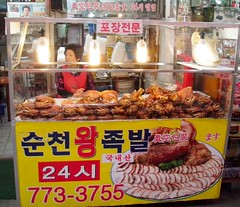
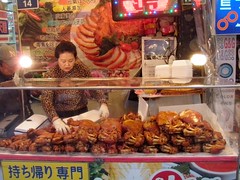
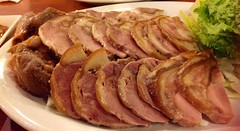
What else to do after such disappointments but to drown my sorrows in a plate of trotters. But I don't know who to trust. Surely a skin-tight leopard shirt points to some indication of higher pork quality.


Hahaha.  If I were only so lucky to have such world-class choices. My closest option is the Pacific East Mall in Richmond which still provides a delicious satisfactory example.  I'm happy again and I have forgotten for the moment my precarious situation of badly aging shengs.


Note: I have been ever so gently reprimanded by the master of the house on my apparent neglect on household matters in favor of tea pursuits.  I have gravely promised (a la Mr. Toad) to reform my addictive ways as well as stop interrogating the master on what he thought of particular shengs he tasted seven years ago.   The head gardener however was inclined to show no such mercy and more roundly rebuked me on multiple occasions finding fault with my indiscriminate watering of the tomato patch. I apparently broke the careful system of dams built with mounds of compost.  I may have to take a small break from blogging this week to amend this deteriorating situation.

Sunday, June 17, 2012

06 Douji Lao Banzhang


I was packing up some samples to send and I could not resist. There is something trustworthy and enticing about Douji cakes.  A friend who was doing a Fulbright in Beijing brought me 4 Douji cakes back in 2006 when the Yiwu Zheng Shan Tea Company was getting the Douji brand off the ground.  This here cake is one of their earlier attempts. I thought I had already opened it years before but here it is unmolested  with a sticker securing the most prim pleats imaginable and now thanks to Jerry of China Cha Dao, you can see exactly how such a thing came to be folded.  There is no good way to peel such a sticker off for mere mortals like me despite this video.
 

Jerry specializes in Douji offerings in his China Chadao ebay store and provides some illuminating history of Douji listings.  YZSTC operate 8 pre-production facilities near each high mountain source to ensure quality.  I do vouch for Douji quality given their relatively low prices at the time and being such a big operation.

Although I have a small box of purportedly pure banzhang rocket fuel cakes,  I only partake in their fragrance from time to time.  Even though I'm not supposed to have any sheng and particularly not any Banzhang,  I pathologically cannot stop myself from brewing it up.  I only try to sip tiny thimblefuls which are surprisingly smooth and refined.   This is a very polite Banzhang I think to myself and even my stomach does not complain yet.

In comparison- a few sips of the 06 Hai Lang Hao Banzhang will induce immediate heart palpitations.  So I'm a bit suspicious that this Douji is not hitting me too hard.  But 15 minutes later,  my hands are shaking and I have trouble arranging tea leaves for a shoot.  By physiological effects alone,  I am going to consider this a bona fide Lao Banzhang cake.  The "rocket fuel" designation is not unwarranted but it does depend on whether or not you are already a hardened coffee or whiskey drinker.


You can see the tell-tale rust hue of oxidation on some of the leaves  but it's such a small portion that you can't tell in the brew.  Even after 6 years, this LBZ has not yielded any signs of aging.

Pure Lao Banzhang cakes are dangerous- it's like the 99% cacao bars that appear on the market.  Just handfuls of leaves should give a blend a taste of that LBZ unrestrained power but instead pure cakes become a legal alternative to methamphetamine. The jittery nervous feeling that Banzhang causes my system is not a pleasant one but their heady perfume in the box is enough for me to keep them around just for late night sniffing.

In the heart of my tiny house, I have about 15 kilos of sheng I am not supposed to partake until another good 10 years.  It's a bit maddening.  In the meanwhile, I bought some Douji ripe from China Chadao to tide me over in the intervening years. 

Friday, June 01, 2012

Revisiting the 2006 Live Journal Tasteoff with the 2003 Feng Zing Zodiac

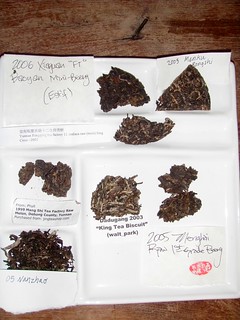
In 2006, bearsbearsbears brilliantly organized a Live Journal pu-erh taste-off which was a great way of sharing within the community.  I still have these treasured samples which I have stored in an airtight tin for 6 years so it may answer some questions I have aging under sealed conditions.

Just from color of the leaves alone, it looks like these guys changed some because none of them have that greenish young sheng tinge.  Without squinting, the 2006 Xiaguan FT and the 2005 Nanzhao definitely looks darker than the 1999 Mangshi Melon. So how do they taste?  I may take decades to find out.

I still have sizeable chunks left because you will see from my setup below that I only need a pinky tip's worth and the samples were generous.  My sheng tasting teapot is about the size of a walnut so it allows me to make numerous infusions without having to drink a litre.

I chose the 2003 Feng Qing Zodiac for this morning since I drink the 2001 Feng Qing Ripe regularly and I had planned to do a little creative shu-sheng blending after the show...  Feng Qing Factory in Lincang is one of the original factories(1939) which has the recipe last digit #4 after Xiaguan #3. They changed their name to Dian Hong group but I have only seen low-end pu-erh from them recently. The 2003 Zodiac appears to have been a special issue and it was not on sale over the internet even back then.

This mini is now a 10 year old and the brew color is still roughly similar to what it was in 2006 as compared with Jason's review.   I normally take a few sips for flavor and dump the rest into the larger bowl which you can see looks darker but the color in the cup is still the hay hues of a youngster.   It must have matured if only a little because the smokiness and grassy green notes which were definitely present in it's infancy were gone.  The bitterness was slight, not harsh at all.  Only after the 6th brewing, I tasted some slight camphor notes.  

It's kind of pleasant albeit boring tea but it still ripped up my stomach.  You can see from the spent leaves that it's  pretty much plantation leaves. I cherry picked the whole leaves but there's no shortage of broken leaves and stems in the teapot.


Aging is occurring albeit very slowly and due to my limited experience with dry-aged sheng tens and tweens, I'm not sure really what to expect. I went through Hobbe's posts for 2002/2003 tastings and his brews definitely look darker. So back to my previous post about aging in sealed conditions, these samples were in ziplock bags in a airtight puzzle tin for 6 years.  Some aging has occurred. But for my collection, I have to find out if they aged any more quickly than my cakes which were sitting on a shelf.   Also I have to account for differences in sample size vs. whole beengs as the rate of aging for broken samples should be somewhat accelerated. The real problem is that I can't tolerate sheng so I can't do serious taste testings to efficiently determine this fact. The only solution is to send away samples to experienced drinkers. 


Wednesday, July 25, 2007

2004 XG Canger Tuo

I'm conducting a wee experiment in aging. It's been a tad dry in Berkeley even with the fog. When I opened up the XG Canger Tuo box- it smelled of nothing. So I put the tuo under my cake dome with a jar of water, all covered for privacy. Wouldn't want the little guy to be too shy to age. Every day, the sheng smell is slowly returning, so today I flake off a few leaves for a tasting.

I normally use my lilliputian pot, wet leaves a quarter of the volume. During the first rinse, spicy notes tickle my nose.
1st 10s lightly drying
2nd 20s, dominant peppery notes but not punchy.
6s,5s,5s,5s,5s,90s,30m spicy notes continue. It's neither floral, woody or hay moderately smooth. I'm having trouble finding the supposed camphor. While picking through the leaves, I get a pleasant sweetness on the bottom half of my tongue.

Wrap up: Pepperiness is the most interesting facet of this tea. Surprising since most of the tea is buds and stems. I'll try in a few months or so to see if time in the dome produced any worthwhile results.